Valley Advocate Springfield · Springfield, Massachusetts · · Page 32
Cuddly Robots
Marcia Biederman
Transcript
It's 10 in the morning, and the Chuck E. Cheese Pizza Time Theatre in Orange, Conn. hasn't opened yet, but two employees are going to turn on the robots for me. General manager Mark Shay flips a switch on the TEAC X-7 Mark II tape deck, and a Broadway medley plays. Giant furry robots, including the enormous grinning rat who is the Pizza Time mascot, sluggishly move heads, paws and beaks. "Their eyes are closed," cries promotional coordinator Leslie Diver, alarmed. Shay explains that it always takes them a while to get up to speed. It is, after all, only 10 in the morning.
Atari founder Nolan Bushnell's second enterprise, Pizza Time Theatre, Inc. will have 300 family entertainment centers nationwide before the end of 1983. Each center has computer-controlled robot characters animated through a system called Cyberamics. The characters' movement and lighting cues are synchronized to voice and music recordings. Volume automatically adjusts to the noise in the room, which can be considerable. This place is for kids.
Movement is programmed by professional animators at a Pizza Time manufacturing facility in Milpitas, Calif. It takes five hours to program each minute of recorded skit material, and the results show it. Every Saturday, says Diver, "the place is packed, and children dance and sing along with the robots. Away from the Pizza Time Players, their Warblelette chicken chorus, and the American, Connecticut and Chuck E. Cheese flags which wave on the wall, an eight-foot lion called "The King" sings and strums Presley classics.
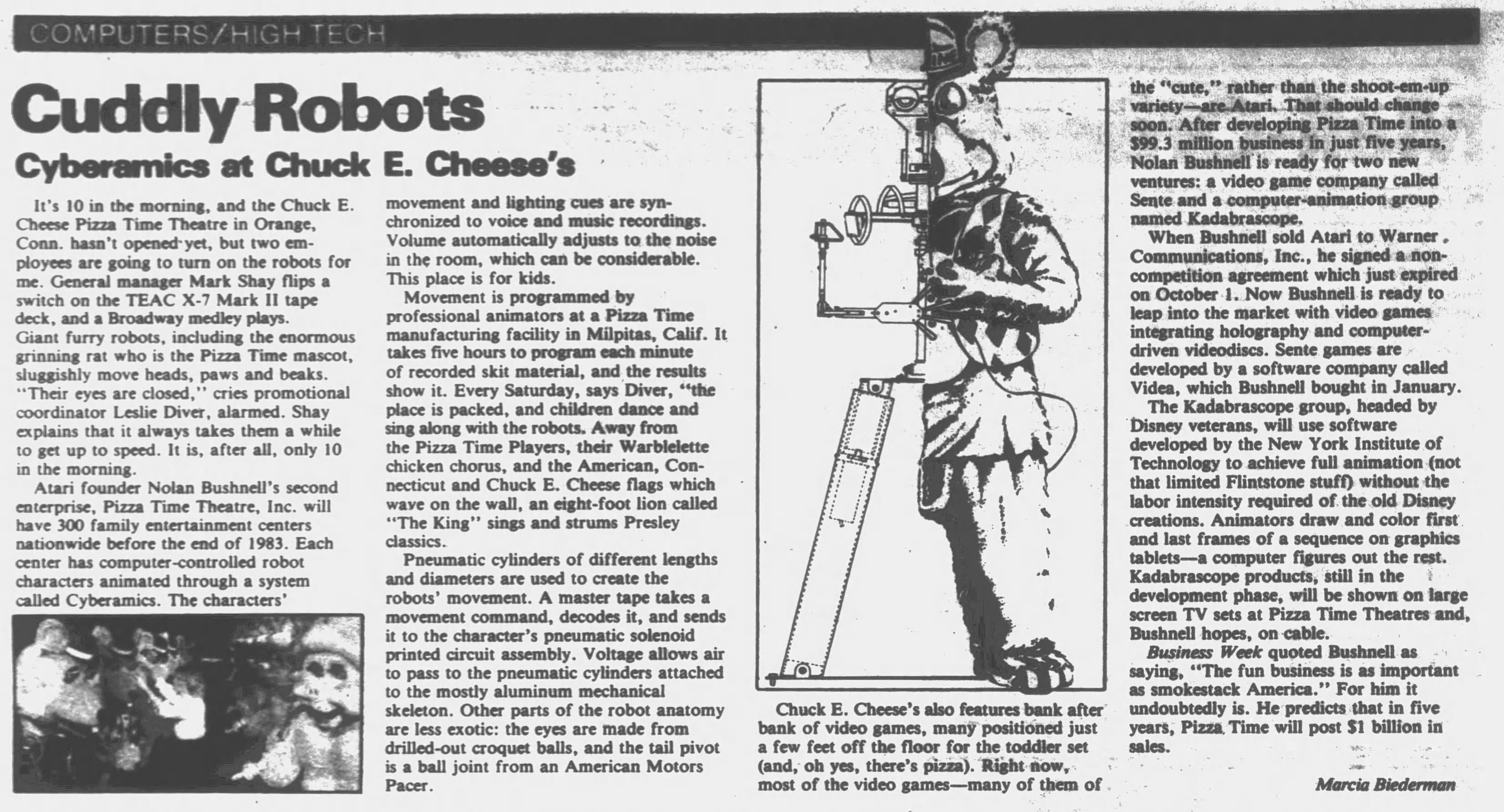
Pneumatic cylinders of different lengths and diameters are used to create the robots' movement. A master tape takes a movement command, decodes it, and sends it to the character's pneumatic solenoid printed circuit assembly. Voltage allows air to pass to the pneumatic cylinders attached to the mostly aluminum mechanical skeleton. Other parts of the robot anatomy are less exotic: the eyes are made from drilled-out croquet balls, and the tail pivot is a ball joint from an American Motors Pacer.
Chuck E. Cheese's also features bank after bank of video games, many positioned just a few feet off the floor for the toddler set (and, oh yes, there's pizza). Right now, most of the video games—many of them of the "cute," rather than the shoot-em-up variety—are Atari. That should change soon. After developing Pizza Time into a $99.3 million business in just five years, Nolan Bushnell is ready for two new ventures: a video game company called Sente and a computer-animation group named Kadabrascope.
When Bushnell sold Atari to Warner Communications, Inc., he signed a non-competition agreement which just expired on October 1. Now Bushnell is ready to leap into the market with video games integrating holography and computer-driven videodiscs. Sente games are developed by a software company called Videa, which Bushnell bought in January.
The Kadabrascope group, headed by Disney veterans, will use software developed by the New York Institute of Technology to achieve full animation (not that limited Flintstone stuff) without the labor intensity required of the old Disney creations. Animators draw and color first and last frames of a sequence on graphics tablets—a computer figures out the rest. Kadabrascope products, still in the development phase, will be shown on large screen TV sets at Pizza Time Theatres and, Bushnell hopes, on cable.
Business Week quoted Bushnell as saying, "The fun business is as important as smokestack America." For him it undoubtedly is. He predicts that in five years, Pizza Time will post $1 billion in sales.