The Journal · Meriden, Connecticut · · Page 11
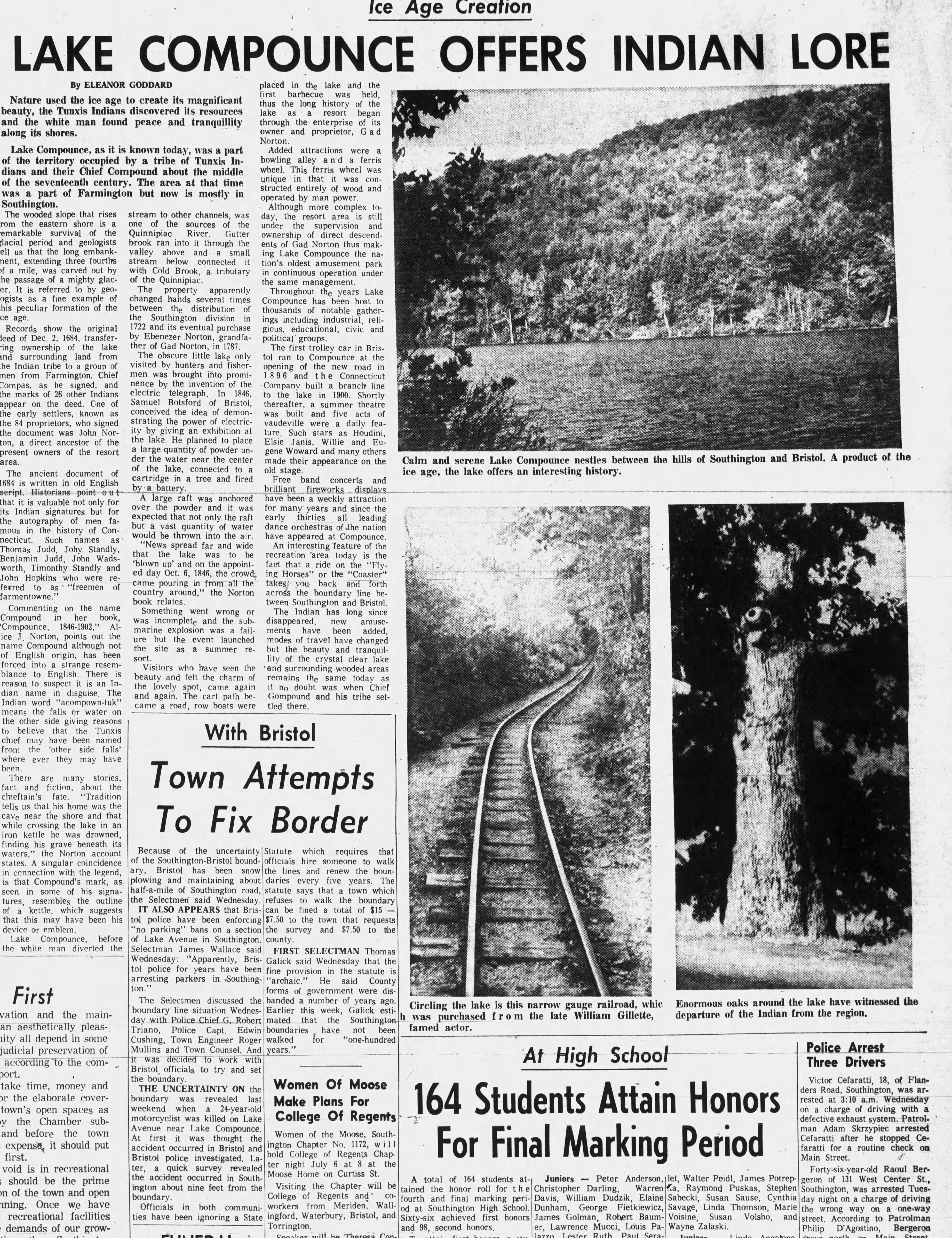
Lake Compounce Offers Indian Lore
By ELEANOR GODDARD
Transcript
Nature used the ice age to create its magnificant beauty, the Tunxis Indians discovered its resources and the white man found peace and tranquillity along its shores.
Lake Compounce, as it is known today, was a part of the territory occupied by a tribe of Tunxis Indians and their Chief Compound about the middle of the seventeenth century. The area at that time was a part of Farmington but now is mostly in Southington.
The wooded slope that rises from the eastern shore is a remarkable survival of the glacial period and geologists tell us that the long embankment, extending three fourths of a mile, was carved out by the passage of a mighty glacier. It is referred to by geologists as a fine example of this peculiar formation of the ice age.
Records show the original deed of Dec. 2, 1684, transferring ownership of the lake and surrounding land from the Indian tribe to a group of men from Farmington. Chief Compas, as he signed, and the marks of 26 other Indians appear on the deed. One of the early settlers, known as the 84 proprietors, who signed the document was John Norton, a direct ancestor of the present owners of the resort area.
The ancient document of 1684 is written in old English script. Historians point out that it is valuable not only for its Indian signatures but for the autography of men famous in the history of Connecticut. Such names as Thomas Judd, Johy Standly, Benjamin Judd, John Wadsworth, Timonthy Standly and John Hopkins who were referred to as "freemen of farmentowne."
Commenting on the name Compound in her book, "Compounce, 1846-1902," Alice J. Norton, points out the name Compound although not of English origin, has been forced into a strange resemblance to English. There is reason to suspect it is an Indian name in disguise. The Indian word "acompown-tuk" means the falls or water on the other side giving reasons to believe that the Tunxis chief may have been named from the 'other side falls' where ever they may have been.
There are many stories, fact and fiction, about the chieftain's fate. "Tradition tells us that his home was the cave near the shore and that while crossing the lake in an iron kettle he was drowned, finding his grave beneath its waters," the Norton account states. A singular coincidence in connection with the legend, is that Compound's mark, as seen in some of his signatures, resembles the outline of a kettle, which suggests that this may have been his device or emblem.
Lake Compounce, before the white man diverted the stream to other channels, was one of the sources of the Quinnipiac River. Gutter brook ran into it through the valley above and a small stream below connected it with Cold Brook, a tributary of the Quinnipiac.
The property apparently changed hands several times between the distribution of the Southington division in 1722 and its eventual purchase by Ebenezer Norton, grandfather of Gad Norton, in 1787.
The obscure little lake only visited by hunters and fishermen was brought into prominence by the invention of the electric telegraph. In 1846, Samuel Botsford of Bristol, conceived the idea of demonstrating the power of electricity by giving an exhibition at the lake. He planned to place a large quantity of powder under the water near the center of the lake, connected to a cartridge in a tree and fired by a battery.
A large raft was anchored over the powder and it was expected that not only the raft but a vast quantity of water would be thrown into the air.
"News spread far and wide that the lake was to be 'blown up' and on the appointed day Oct. 6, 1846, the crowd came pouring in from all the country around," the Norton book relates.
Something went wrong or was incomplete and the submarine explosion was a failure but the event launched the site as a summer resort.
Visitors who have seen the beauty and felt the charm of the lovely spot, came again and again. The cart path became a road, row boats were placed in the lake and the first barbecue was held, thus the long history of the lake as a resort began through the enterprise of its owner and proprietor, Gad Norton.
Added attractions were a bowling alley and a ferris wheel. This ferris wheel was unique in that it was constructed entirely of wood and operated by man power.
Although more complex today, the resort area is still under the supervision and ownership of direct descendents of Gad Norton thus making Lake Compounce the nation's oldest amusement park in continuous operation under the same management.
Throughout the years Lake Compounce has been host to thousands of notable gatherings including industrial, religious, educational, civic and political groups.
The first trolley car in Bristol ran to Compounce at the opening of the new road in 1896 and the Connecticut Company built a branch line to the lake in 1900. Shortly thereafter, a summer theatre was built and five acts of vaudeville were a daily feature. Such stars as Houdini, Elsie Janis, Willie and Eugene Woward and many others made their appearance on the old stage.
Free band concerts and brilliant fireworks displays have been a weekly attraction for many years and since the early thirties all leading dance orchestras of the nation have appeared at Compounce.
An interesting feature of the recreation area today is the fact that a ride on the "Flying Horses" or the "Coaster" takes you back and forth across the boundary line between Southington and Bristol.
The Indian has long since disappeared, new amusements have been added, modes of travel have changed but the beauty and tranquility of the crystal clear lake and surrounding wooded areas remains the same today as it no doubt was when Chief Gompound and his tribe settled there.
[Photo caption] Calm and serene Lake Compounce nestles between the hills of Southington and Bristol. A product of the ice age, the lake offers an interesting history.
[Photo caption] Circling the lake is this narrow gauge railroad, which was purchased from the late William Gillette, famed actor.
[Photo caption] Enormous oaks around the lake have witnessed the departure of the Indian from the region.