Arizona Republic · Phoenix, Arizona · · Page A6
Legend City
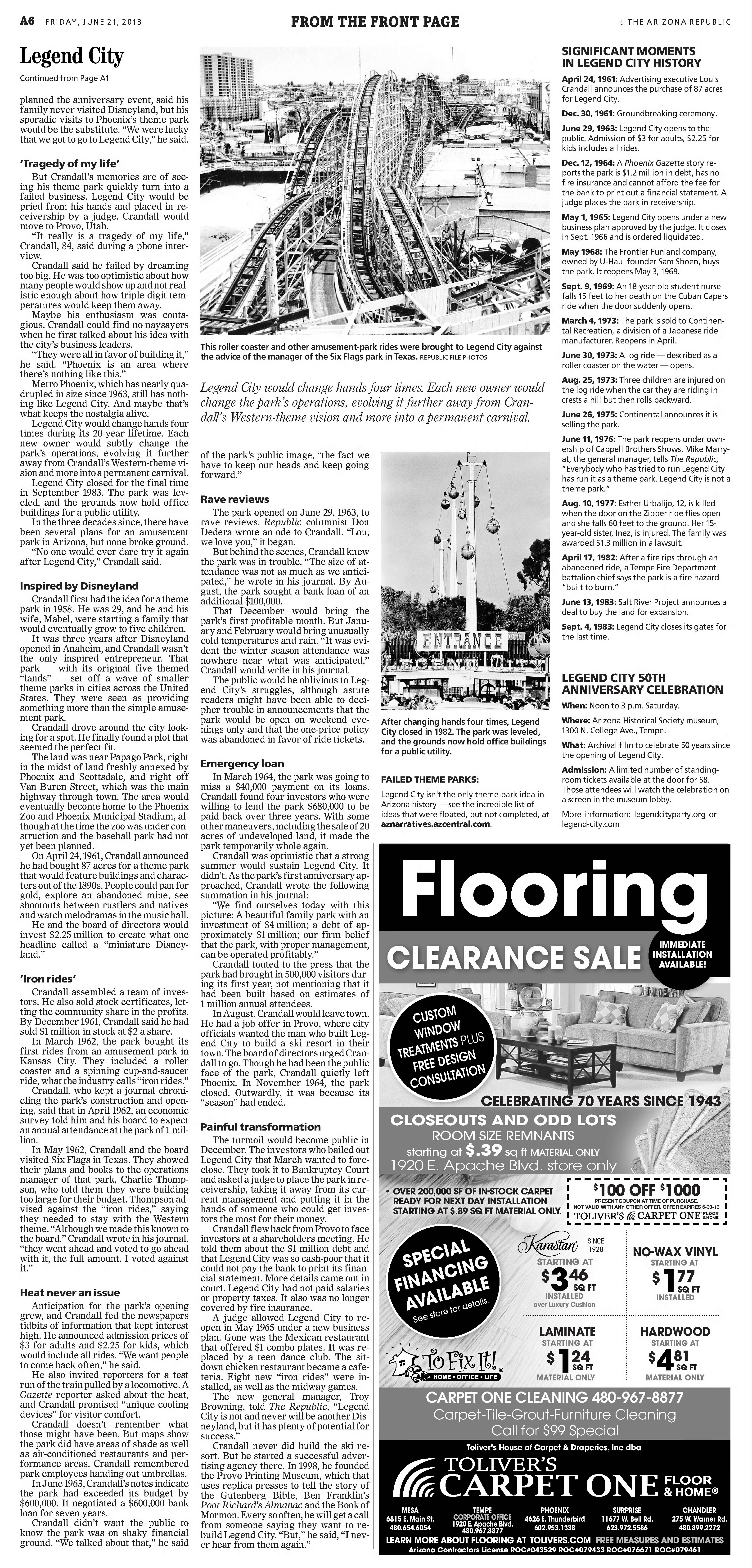
Transcript
Continued from Page A1
planned the anniversary event, said his family never visited Disneyland, but his sporadic visits to Phoenix’s theme park would be the substitute. “We were lucky that we got to go to Legend City,” he said.
‘Tragedy of my life’
But Crandall’s memories are of seeing his theme park quickly turn into a failed business. Legend City would be pried from his hands and placed in receivership by a judge. Crandall would move to Provo, Utah.
“It really is a tragedy of my life,” Crandall, 84, said during a phone interview.
Crandall said he failed by dreaming too big. He was too optimistic about how many people would show up and not realistic enough about how triple-digit temperatures would keep them away.
Maybe his enthusiasm was contagious. Crandall could find no naysayers when he first talked about his idea with the city’s business leaders.
“They were all in favor of building it,” he said. “Phoenix is an area where there’s nothing like this.”
Metro Phoenix, which has nearly quadrupled in size since 1963, still has nothing like Legend City. And maybe that’s what keeps the nostalgia alive.
Legend City would change hands four times during its 20-year lifetime. Each new owner would subtly change the park’s operations, evolving it further away from Crandall’s Western-theme vision and more into a permanent carnival.
Legend City closed for the final time in September 1983. The park was leveled, and the grounds now hold office buildings for a public utility.
In the three decades since, there have been several plans for an amusement park in Arizona, but none broke ground.
“No one would ever dare try it again after Legend City,” Crandall said.
Inspired by Disneyland
Crandall first had the idea for a theme park in 1958. He was 29, and he and his wife, Mabel, were starting a family that would eventually grow to five children.
It was three years after Disneyland opened in Anaheim, and Crandall wasn’t the only inspired entrepreneur. That park — with its original five themed “lands” — set off a wave of smaller theme parks in cities across the United States. They were seen as providing something more than the simple amusement park.
Crandall drove around the city looking for a spot. He finally found a plot that seemed the perfect fit.
The land was near Papago Park, right in the midst of land freshly annexed by Phoenix and Scottsdale, and right off Van Buren Street, which was the main highway through town. The area would eventually become home to the Phoenix Zoo and Phoenix Municipal Stadium, although at the time the zoo was under construction and the baseball park had not yet been planned.
On April 24, 1961, Crandall announced he had bought 87 acres for a theme park that would feature buildings and characters out of the 1890s. People could pan for gold, explore an abandoned mine, see shootouts between rustlers and natives and watch melodramas in the music hall.
He and the board of directors would invest $2.25 million to create what one headline called a “miniature Disneyland.”
‘Iron rides’
Crandall assembled a team of investors. He also sold stock certificates, letting the community share in the profits. By December 1961, Crandall said he had sold $1 million in stock at $2 a share.
In March 1962, the park bought its first rides from an amusement park in Kansas City. They included a roller coaster and a spinning cup-and-saucer ride, what the industry calls “iron rides.”
Crandall, who kept a journal chronicling the park’s construction and opening, said that in April 1962, an economic survey told him and his board to expect an annual attendance at the park of 1 million.
In May 1962, Crandall and the board visited Six Flags in Texas. They showed their plans and books to the operations manager of that park, Charlie Thompson, who told them they were building too large for their budget. Thompson advised against the “iron rides,” saying they needed to stay with the Western theme. “Although we made this known to the board,” Crandall wrote in his journal, “they went ahead and voted to go ahead with it, the full amount. I voted against it.”
Heat never an issue
Anticipation for the park’s opening grew, and Crandall fed the newspapers tidbits of information that kept interest high. He announced admission prices of $3 for adults and $2.25 for kids, which would include all rides. “We want people to come back often,” he said.
He also invited reporters for a test run of the train pulled by a locomotive. A Gazette reporter asked about the heat, and Crandall promised “unique cooling devices” for visitor comfort.
Crandall doesn’t remember what those might have been. But maps show the park did have areas of shade as well as air-conditioned restaurants and performance areas. Crandall remembered park employees handing out umbrellas.
In June 1963, Crandall’s notes indicate the park had exceeded its budget by $600,000. It negotiated a $600,000 bank loan for seven years.
Crandall didn’t want the public to know the park was on shaky financial ground. “We talked about that,” he said of the park’s public image, “the fact we have to keep our heads and keep going forward.”
Rave reviews
The park opened on June 29, 1963, to rave reviews. Republic columnist Don Dedera wrote an ode to Crandall. “Lou, we love you,” it began.
But behind the scenes, Crandall knew the park was in trouble. “The size of attendance was not as much as we anticipated,” he wrote in his journal. By August, the park sought a bank loan of an additional $100,000.
That December would bring the park’s first profitable month. But January and February would bring unusually cold temperatures and rain. “It was evident the winter season attendance was nowhere near what was anticipated,” Crandall would write in his journal.
The public would be oblivious to Legend City’s struggles, although astute readers might have been able to decipher trouble in announcements that the park would be open on weekend evenings only and that the one-price policy was abandoned in favor of ride tickets.
Emergency loan
In March 1964, the park was going to miss a $40,000 payment on its loans. Crandall found four investors who were willing to lend the park $680,000 to be paid back over three years. With some other maneuvers, including the sale of 20 acres of undeveloped land, it made the park temporarily whole again.
Crandall was optimistic that a strong summer would sustain Legend City. It didn’t. As the park’s first anniversary approached, Crandall wrote the following summation in his journal:
“We find ourselves today with this picture: A beautiful family park with an investment of $4 million; a debt of approximately $1 million; our firm belief that the park, with proper management, can be operated profitably.”
Crandall touted to the press that the park had brought in 500,000 visitors during its first year, not mentioning that it had been built based on estimates of 1 million annual attendees.
In August, Crandall would leave town. He had a job offer in Provo, where city officials wanted the man who built Legend City to build a ski resort in their town. The board of directors urged Crandall to go. Though he had been the public face of the park, Crandall quietly left Phoenix. In November 1964, the park closed. Outwardly, it was because its “season” had ended.
Painful transformation
The turmoil would become public in December. The investors who bailed out Legend City that March wanted to foreclose. They took it to Bankruptcy Court and asked a judge to place the park in receivership, taking it away from its current management and putting it in the hands of someone who could get investors the most for their money.
Crandall flew back from Provo to face investors at a shareholders meeting. He told them about the $1 million debt and that Legend City was so cash-poor that it could not pay the bank to print its financial statement. More details came out in court. Legend City had not paid salaries or property taxes. It also was no longer covered by fire insurance.
A judge allowed Legend City to reopen in May 1965 under a new business plan. Gone was the Mexican restaurant that offered $1 combo plates. It was replaced by a teen dance club. The sit-down chicken restaurant became a cafeteria. Eight new “iron rides” were installed, as well as the midway games.
The new general manager, Troy Browning, told The Republic, “Legend City is not and never will be another Disneyland, but it has plenty of potential for success.”
Crandall never did build the ski resort. But he started a successful advertising agency there. In 1998, he founded the Provo Printing Museum, which that uses replica presses to tell the story of the Gutenberg Bible, Ben Franklin’s Poor Richard’s Almanac and the Book of Mormon. Every so often, he will get a call from someone saying they want to rebuild Legend City. “But,” he said, “I never hear from them again.”
[Photo caption] This roller coaster and other amusement-park rides were brought to Legend City against the advice of the manager of the Six Flags park in Texas. REPUBLIC FILE PHOTOS
[Photo caption] After changing hands four times, Legend City closed in 1982. The park was leveled, and the grounds now hold office buildings for a public utility.