Palo Alto Times · Palo Alto, California · · Page 35
Not Hard to Tell Whose Office You're In
By Paul Voakes, Times Staff Writer
Transcript
Just walk through the office door and you know you're in a Nolan Bushnell enterprise.
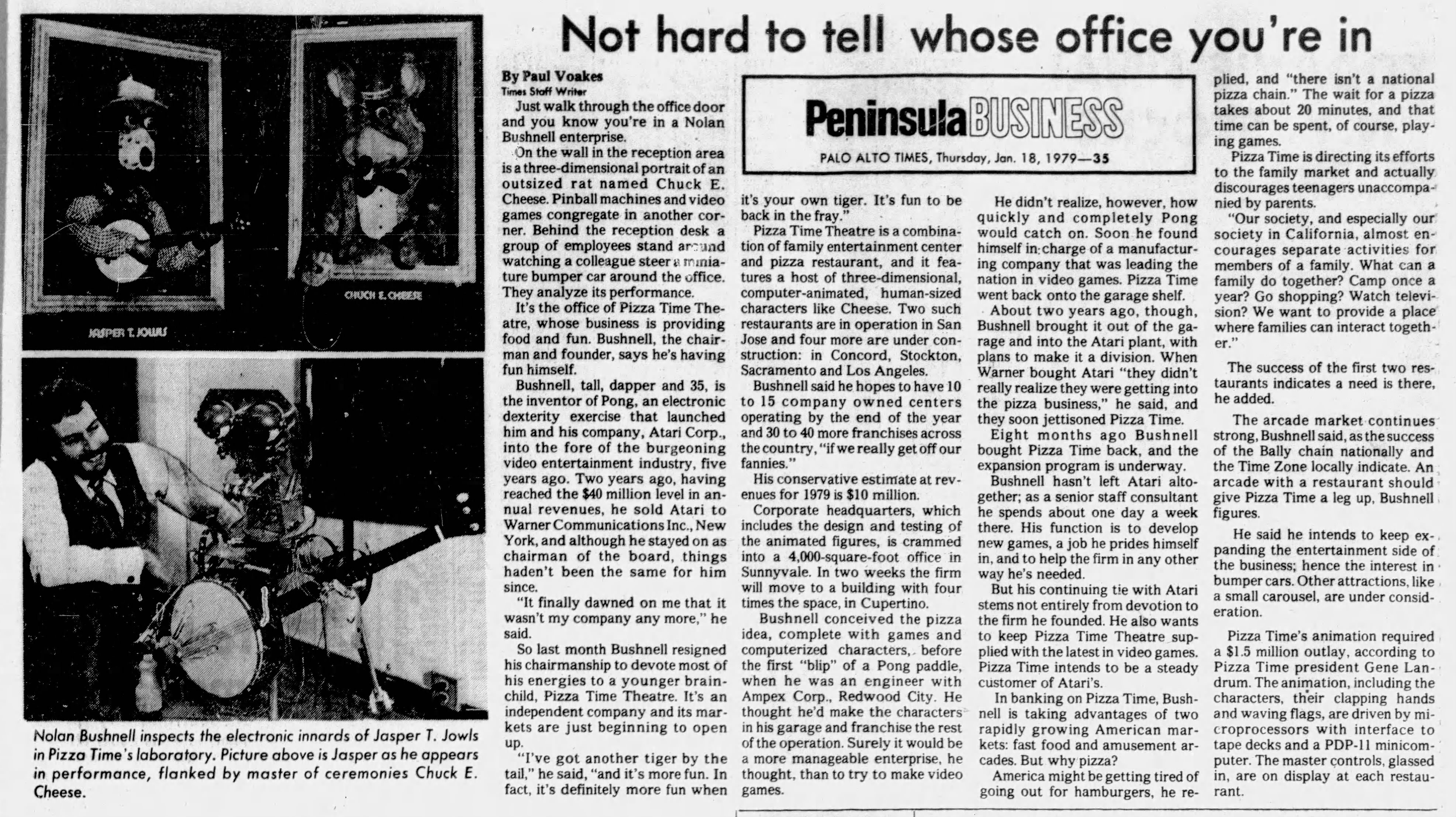
On the wall in the reception area is a three-dimensional portrait of an outsized rat named Chuck E. Cheese. Pinball machines and video games congregate in another corner. Behind the reception desk a group of employees stand around watching a colleague steer a miniature bumper car around the office. They analyze its performance.
It's the office of Pizza Time Theatre, whose business is providing food and fun. Bushnell, the chairman and founder, says he's having fun himself.
Bushnell, tall, dapper and 35, is the inventor of Pong, an electronic dexterity exercise that launched him and his company, Atari Corp., into the fore of the burgeoning video entertainment industry, five years ago. Two years ago, having reached the $40 million level in annual revenues, he sold Atari to Warner Communications Inc., New York, and although he stayed on as chairman of the board, things haden't been the same for him since.
"It finally dawned on me that it wasn't my company any more," he said.
So last month Bushnell resigned his chairmanship to devote most of his energies to a younger brainchild, Pizza Time Theatre. It's an independent company and its markets are just beginning to open up.
"I've got another tiger by the tail," he said, "and it's more fun. In fact, it's definitely more fun when it's your own tiger. It's fun to be back in the fray."
Pizza Time Theatre is a combination of family entertainment center and pizza restaurant, and it features a host of three-dimensional, computer-animated, human-sized characters like Cheese. Two such restaurants are in operation in San Jose and four more are under construction: in Concord, Stockton, Sacramento and Los Angeles.
Bushnell said he hopes to have 10 to 15 company owned centers operating by the end of the year and 30 to 40 more franchises across the country, "if we really get off our fannies."
His conservative estimate at revenues for 1979 is $10 million.
Corporate headquarters, which includes the design and testing of the animated figures, is crammed into a 4,000-square-foot office in Sunnyvale. In two weeks the firm will move to a building with four times the space, in Cupertino.
Bushnell conceived the pizza idea, complete with games and computerized characters, before the first "blip" of a Pong paddle, when he was an engineer with Ampex Corp., Redwood City. He thought he'd make the characters in his garage and franchise the rest of the operation. Surely it would be a more manageable enterprise, he thought, than to try to make video games.
He didn't realize, however, how quickly and completely Pong would catch on. Soon he found himself in charge of a manufacturing company that was leading the nation in video games. Pizza Time went back onto the garage shelf.
About two years ago, though, Bushnell brought it out of the garage and into the Atari plant, with plans to make it a division. When Warner bought Atari "they didn't really realize they were getting into the pizza business," he said, and they soon jettisoned Pizza Time.
Eight months ago Bushnell bought Pizza Time back, and the expansion program is underway.
Bushnell hasn't left Atari altogether; as a senior staff consultant he spends about one day a week there. His function is to develop new games, a job he prides himself in, and to help the firm in any other way he's needed.
But his continuing tie with Atari stems not entirely from devotion to the firm he founded. He also wants to keep Pizza Time Theatre supplied with the latest in video games. Pizza Time intends to be a steady customer of Atari's.
In banking on Pizza Time, Bushnell is taking advantages of two rapidly growing American markets: fast food and amusement arcades. But why pizza?
America might be getting tired of going out for hamburgers, he replied, and "there isn't a national pizza chain." The wait for a pizza takes about 20 minutes, and that time can be spent, of course, playing games.
Pizza Time is directing its efforts to the family market and actually discourages teenagers unaccompanied by parents.
"Our society, and especially our society in California, almost encourages separate activities for members of a family. What can a family do together? Camp once a year? Go shopping? Watch television? We want to provide a place where families can interact together."
The success of the first two restaurants indicates a need is there, he added.
The arcade market continues strong, Bushnell said, as the success of the Bally chain nationally and the Time Zone locally indicate. An arcade with a restaurant should give Pizza Time a leg up, Bushnell figures.
He said he intends to keep expanding the entertainment side of the business; hence the interest in bumper cars. Other attractions, like a small carousel, are under consideration.
Pizza Time's animation required a $1.5 million outlay, according to Pizza Time president Gene Landrum. The animation, including the characters, their clapping hands and waving flags, are driven by microprocessors with interface to tape decks and a PDP-11 minicomputer. The master controls, glassed in, are on display at each restaurant.
[Photo caption] Nolan Bushnell inspects the electronic innards of Jasper T. Jowls in Pizza Time's laboratory. Picture above is Jasper as he appears in performance, flanked by master of ceremonies Chuck E. Cheese.