The Springfield News-Leader · Springfield, Missouri · · Page 25
Pizza-joint jazz gives way to boop-beep theater
Sarah Overstreet
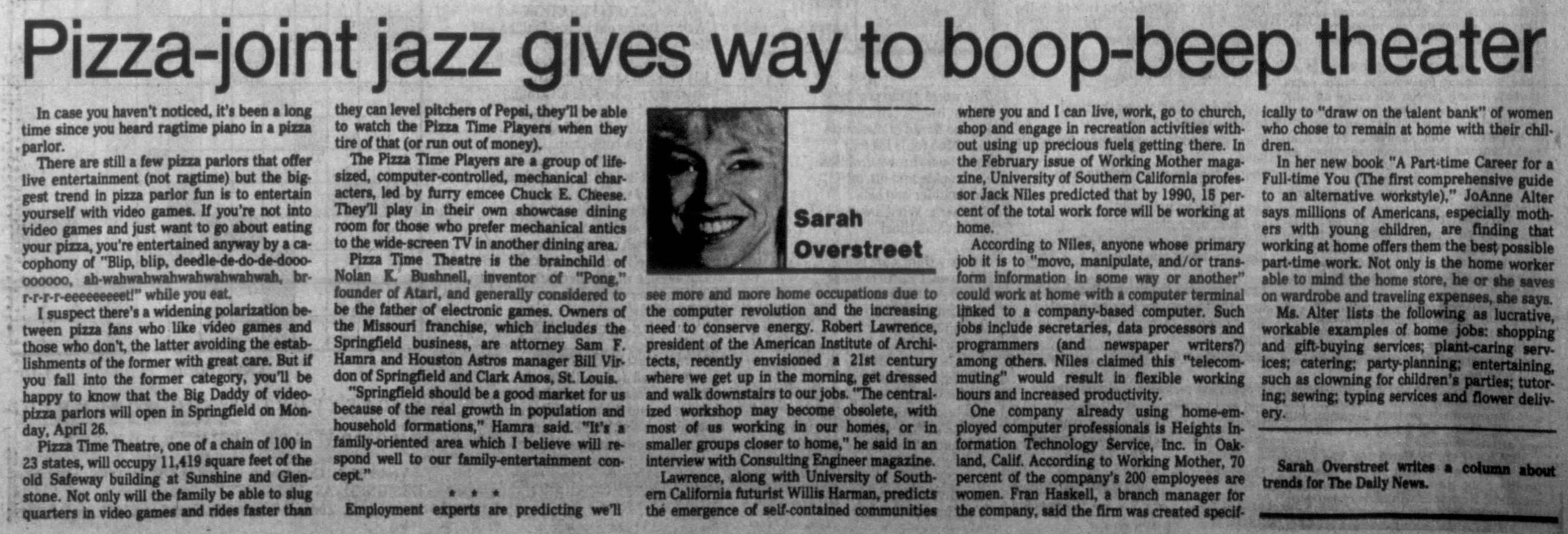
Transcript
In case you haven’t noticed, it’s been a long time since you heard ragtime piano in a pizza parlor.
There are still a few pizza parlors that offer live entertainment (not ragtime) but the biggest trend in pizza parlor fun is to entertain yourself with video games. If you’re not into video games and just want to go about eating your pizza, you’re entertained anyway by a cacophony of “Blip, blip, deedle-de-do-de-dooooooooo, ah-wahwahwahwahwahwahwahwah, brr-r-r-r-eeeeeeeeet!” while you eat.
I suspect there’s a widening polarization between pizza fans who like video games and those who don’t, the latter avoiding the establishments of the former with great care. But if you fall into the former category, you’ll be happy to know that the Big Daddy of video-pizza parlors will open in Springfield on Monday, April 26.
Pizza Time Theatre, one of a chain of 100 in 23 states, will occupy 11,419 square feet of the old Safeway building at Sunshine and Glenstone. Not only will the family be able to slug quarters in video games and rides faster than they can level pitchers of Pepsi, they’ll be able to watch the Pizza Time Players when they tire of that (or run out of money).
The Pizza Time Players are a group of life-sized, computer-controlled, mechanical characters, led by furry emcee Chuck E. Cheese. They’ll play in their own showcase dining room for those who prefer mechanical antics to the wide-screen TV in another dining area.
Pizza Time Theatre is the brainchild of Nolan K. Bushnell, inventor of “Pong,” founder of Atari, and generally considered to be the father of electronic games. Owners of the Missouri franchise, which includes the Springfield business, are attorney Sam F. Hamra and Houston Astros manager Bill Virdon of Springfield and Clark Amos, St. Louis.
“Springfield should be a good market for us because of the real growth in population and household formations,” Hamra said. “It’s a family-oriented area which I believe will respond well to our family-entertainment concept.”
* * *
Employment experts are predicting we’ll see more and more home occupations due to the computer revolution and the increasing need to conserve energy. Robert Lawrence, president of the American Institute of Architects, recently envisioned a 21st century where we get up in the morning, get dressed and walk downstairs to our jobs. “The centralized workshop may become obsolete, with most of us working in our homes, or in smaller groups closer to home,” he said in an interview with Consulting Engineer magazine.
Lawrence, along with University of Southern California futurist Willis Harman, predicts the emergence of self-contained communities where you and I can live, work, go to church, shop and engage in recreation activities without using up precious fuels getting there. In the February issue of Working Mother magazine, University of Southern California professor Jack Niles predicted that by 1990, 15 percent of the total work force will be working at home.
According to Niles, anyone whose primary job it is to “movo [?], manipulate, and/or transform information in some way or another” could work at home with a computer terminal linked to a company-based computer. Such jobs include secretaries, data processors and programmers (and newspaper writers?) among others. Niles claimed this “telecommuting” would result in flexible working hours and increased productivity.
One company already using home-employed computer professionals is Heights Information Technology Service, Inc. in Oakland, Calif. According to Working Mother, 70 percent of the company’s 200 employees are women. Fran Haskell, a branch manager for the company, said the firm was created specifically to “draw on the talent bank” of women who chose to remain at home with their children.
In her new book “A Part-time Career for a Full-time You (The first comprehensive guide to an alternative workstyle),” JoAnne Alter says millions of Americans, especially mothers with young children, are finding that working at home offers them the best possible part-time work. Not only is the home worker able to mind the home store, he or she saves on wardrobe and traveling expenses, she says.
Ms. Alter lists the following as lucrative, workable examples of home jobs: shopping and gift-buying services; plant-caring services; catering; party-planning; entertaining, such as clowning for children’s parties; tutoring; sewing; typing services and flower delivery.
Sarah Overstreet writes a column about trends for The Daily News.