Oakland Tribune · Oakland, California · · Page 25
Pizza Time Theater: paradise for little people's parties
By Peter Cowan, Tribune Staff Writer
Transcript
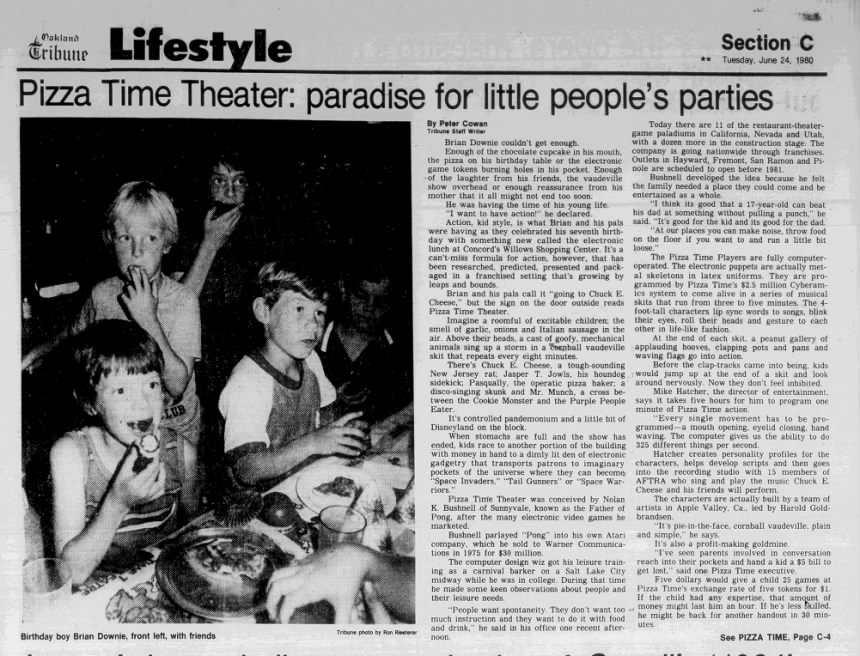
Brian Downie couldn't get enough.
Enough of the chocolate cupcake in his mouth, the pizza on his birthday table or the electronic game tokens burning holes in his pocket. Enough of the laughter from his friends, the vaudeville show overhead or enough reassurance from his mother that it all might not end too soon.
He was having the time of his young life.
"I want to have action!" he declared.
Action, kid style, is what Brian and his pals were having as they celebrated his seventh birthday with something new called the electronic lunch at Concord's Willows Shopping Center. It's a can't-miss formula for action, however, that has been researched, predicted, presented and packaged in a franchised setting that's growing by leaps and bounds.
Brian and his pals call it "going to Chuck E. Cheese," but the sign on the door outside reads Pizza Time Theater.
Imagine a roomful of excitable children; the smell of garlic, onions and Italian sausage in the air. Above their heads, a cast of goofy, mechanical animals sing up a storm in a cornball vaudeville skit that repeats every eight minutes.
There's Chuck E. Cheese, a tough-sounding New Jersey rat; Jasper T. Jowls, his houndog sidekick; Pasqually, the operatic pizza baker; a disco-singing skunk and Mr. Munch, a cross between the Cookie Monster and the Purple People Eater.
It's controlled pandemonium and a little bit of Disneyland on the block.
When stomachs are full and the show has ended, kids race to another portion of the building with money in hand to a dimly lit den of electronic gadgetry that transports patrons to imaginary pockets of the universe where they can become "Space Invaders," "Tail Gunners" or "Space Warriors."
Pizza Time Theater was conceived by Nolan K. Bushnell of Sunnyvale, known as the Father of Pong, after the many electronic video games he marketed.
Bushnell parlayed "Pong" into his own Atari company, which he sold to Warner Communications in 1975 for $30 million.
The computer design wiz got his leisure training as a carnival barker on a Salt Lake City midway while he was in college. During that time he made some keen observations about people and their leisure needs.
"People want spontaneity. They don't want too much instruction and they want to do it with food and drink," he said in his office one recent afternoon.
Today there are 11 of the restaurant-theater-game paladiums in California, Nevada and Utah, with a dozen more in the construction stage. The company is going nationwide through franchises. Outlets in Hayward, Fremont, San Ramon and Pinole are scheduled to open before 1981.
Bushnell developed the idea because he felt the family needed a place they could come and be entertained as a whole.
"I think its good that a 17-year-old can beat his dad at something without pulling a punch," he said. "It's good for the kid and its good for the dad.
"At our places you can make noise, throw food on the floor if you want to and run a little bit loose."
The Pizza Time Players are fully computer-operated. The electronic puppets are actually metal skeletons in latex uniforms. They are programmed by Pizza Time's $2.5 million Cyberamics system to come alive in a series of musical skits that run from three to five minutes. The 4-foot-tall characters lip sync words to songs, blink their eyes, roll their heads and gesture to each other in life-like fashion.
At the end of each skit, a peanut gallery of applauding hooves, clapping pots and pans and waving flags go into action.
Before the clap-tracks came into being, kids would jump up at the end of a skit and look around nervously. Now they don't feel inhibited.
Mike Hatcher, the director of entertainment, says it takes five hours for him to program one minute of Pizza Time action.
"Every single movement has to be programmed—a mouth opening, eyelid closing, hand waving. The computer gives us the ability to do 325 different things per second.
Hatcher creates personality profiles for the characters, helps develop scripts and then goes into the recording studio with 15 members of AFTRA who sing and play the music Chuck E. Cheese and his friends will perform.
The characters are actually built by a team of artists in Apple Valley, Ca., led by Harold Goldbrandsen.
"It's pie-in-the-face, cornball vaudeville, plain and simple," he says.
It's also a profit-making goldmine.
"I've seen parents involved in conversation reach into their pockets and hand a kid a $5 bill to get lost," said one Pizza Time executive.
Five dollars would give a child 25 games at Pizza Time's exchange rate of five tokens for $1. If the child had any expertise, that amount of money might last him an hour. If he's less skilled, he might be back for another handout in 30 minutes.
See PIZZA TIME, Page C-4
[Photo caption] Birthday boy Brian Downie, front left, with friends