Santa Cruz Sentinel · Santa Cruz, California · · Page 59
Presenting Chuck E. Cheese — Success Story
By C.W. Miranker
Transcript
SAN JOSE (AP) — The combination of pizza, Pac-Man and performing robots is fast making Chuck E. Cheese Pizza Time Theatres a fantasy come true for video-happy kids and Wall Street too.
The company recently posted its second-quarter results: revenues up 217 percent to $23.1 million over the same period of 1981; net income up 453 percent to nearly $2 million. And an out-of-court settlement with its closest competitor recently added $750,000 to Pizza Time coffers, with more to come for years.
"It's a very high-revenue business ... much higher than the average fast-food restaurant," says Mary Lisanti of L.F. Rothschild, Unterberg, Towbin in New York.
The brainchild of Nolan K. Bushnell, who launched Atari, Pizza Time solved the problem of what to do while a family waits for pizza.
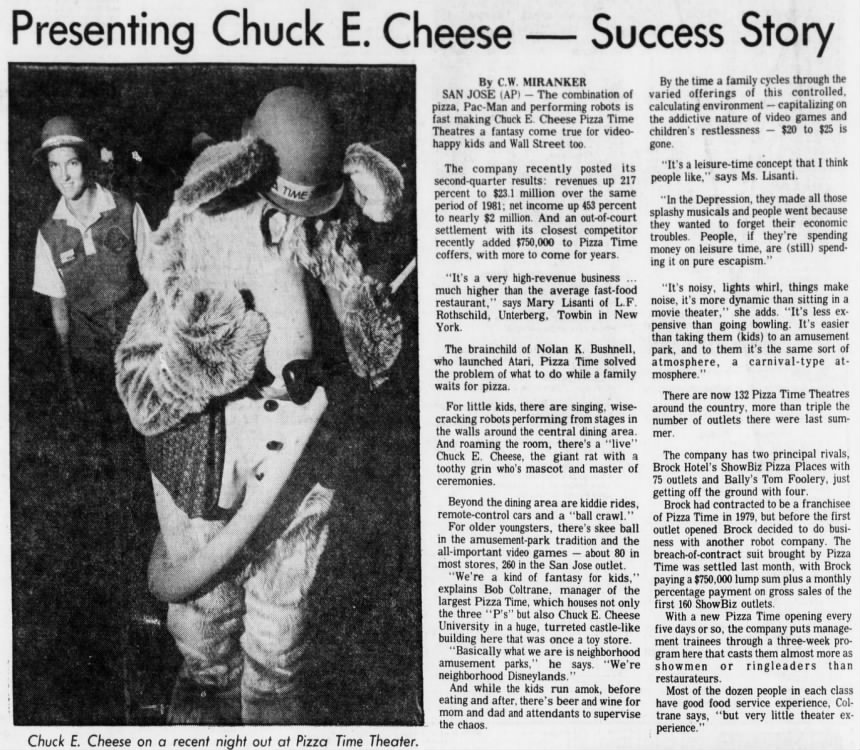
For little kids, there are singing, wise-cracking robots performing from stages in the walls around the central dining area. And roaming the room, there's a "live" Chuck E. Cheese, the giant rat with a toothy grin who's mascot and master of ceremonies.
Beyond the dining area are kiddie rides, remote-control cars and a "ball crawl."
For older youngsters, there's skee ball in the amusement-park tradition and the all-important video games — about 80 in most stores, 260 in the San Jose outlet.
"We're a kind of fantasy for kids," explains Bob Coltrane, manager of the largest Pizza Time, which houses not only the three "P's" but also Chuck E. Cheese University in a huge, turreted castle-like building here that was once a toy store.
"Basically what we are is neighborhood amusement parks," he says. "We're neighborhood Disneylands."
And while the kids run amok, before eating and after, there's beer and wine for mom and dad and attendants to supervise the chaos.
By the time a family cycles through the varied offerings of this controlled, calculating environment — capitalizing on the addictive nature of video games and children's restlessness — $20 to $25 is gone.
"It's a leisure-time concept that I think people like," says Ms. Lisanti.
"In the Depression, they made all those splashy musicals and people went because they wanted to forget their economic troubles. People, if they're spending money on leisure time, are (still) spending it on pure escapism."
"It's noisy, lights whirl, things make noise, it's more dynamic than sitting in a movie theater," she adds. "It's less expensive than going bowling. It's easier than taking them (kids) to an amusement park, and to them it's the same sort of atmosphere, a carnival-type atmosphere."
There are now 132 Pizza Time Theatres around the country, more than triple the number of outlets there were last summer.
The company has two principal rivals, Brock Hotel's ShowBiz Pizza Places with 75 outlets and Bally's Tom Foolery, just getting off the ground with four.
Brock had contracted to be a franchisee of Pizza Time in 1979, but before the first outlet opened Brock decided to do business with another robot company. The breach-of-contract suit brought by Pizza Time was settled last month, with Brock paying a $750,000 lump sum plus a monthly percentage payment on gross sales of the first 160 ShowBiz outlets.
With a new Pizza Time opening every five days or so, the company puts management trainees through a three-week program here that casts them almost more as showmen or ringleaders than restaurateurs.
Most of the dozen people in each class have good food service experience, Coltrane says, "but very little theater experience."
[Photo caption] Chuck E. Cheese on a recent night out at Pizza Time Theater.