The Central New Jersey Home News · New Brunswick, New Jersey · · Page 24
Sesame Place shows kids learning is fun
By SANDRA LANMAN, Home News staff writer
Transcript
LANGHORNE, Pa. — Has your child ever swum in a sea of green balls?
Or scaled a plastic mountain, punched his way out of a maze, or stacked blocks so big he could climb them?
Now he can.
Sesame Place, the New York-Philadelphia area's newest theme park, opened this week on a 15-acre site adjacent to the Oxford Valley Mall.
Described by its creators as “part participatory science museum, part playground of the future and part electronic game center,” Sesame Place is a prototype of its genre — a park designed to involve visitors in all activities.
As is evidenced by its name, Sesame Place is intimately related to its namesake, the television show, “Sesame Street.”
The park is a joint venture of the Children's Television Workshop (CTW), creators of “Sesame Street,” and Busch Entertainment Corp., developers and operators of two theme parks, The Old Country, Busch Gardens in Williamsburg, Va., and The Dark Continent, Busch Gardens in Tampa, Fla. One of the main goals of Sesame Place is to raise money to support CTW's educational television endeavors, company executives said.
But unlike Busch's other ventures, Sesame Place is purposely small, designed to appeal to residents in its geographic area rather than tourists. This area was chosen because of the large number of families with young children — the targeted clientele is the 3-to-13 age group — and its proximity to major highways, according to project manager Gibbs La Motte.
Those who designed the park insisted they have striven for the highest standards. They said they have avoided commercialism as well as passive entertainment.
Visitors won't find Big Bird's picture slapped on the side of a roller coaster or a spin-the-wheel game with stuffed Muppets as prizes. There are no rides at Sesame Place, other than the ones children give themselves on giant slides and other equipment.
According to La Motte, CTW had been approached in the past to put its Muppets in theme parks but declined because “we felt many theme parks are not participatory.”
CTW decided instead to embody its own theories and practices used in educating children within the framework of a theme park. It teamed up with Busch Entertainment Corp., specialists in the latter area, and secured the expertise of some seven experts in areas from playground equipment to computers.
The end result, which was unveiled Tuesday to reporters and their children and Wednesday to the public, is actually two “playgrounds” — outdoor and indoor.
Exercise and fun are the objectives of Sesame Place's outdoor playground, conceived by playground designer Eric McMillan. The area, which may be reached via conventional sidewalks or the swinging “Big Bird Walkway” (from which you descend on a slide or stairway), contains 40 elements designed by the British-born McMillan.
The “Count's Ballroom” is a two-foot deep pool filled with some 80,000 lightweight green plastic balls on a soft foam surface through which kids “swim,” crawl and dive. The idea is said to have sprung from a friend's impractical desire to play in a jar of pickled onions. “The idea was fascinating,” McMillan recalled. “So we took it from there. That's often how a lot of our ideas come.”
The “Monster Maze” contains six-foot high punching bags through which youngsters punch their way from one side to the other.
The “Sesame Street Construction Company” is a wood-chip-covered pit filled with giant interlocking polyurethane blocks with Swiss cheese holes for stacking and climbing.
For the strong and daring, there is an activity called “Hands Over Water” containing rings and rope ladders suspended over a pool of water. Participants are supposed to fall on to dry air mattresses atop the water if they aren't able to carry themselves across the pool but the air mattresses sometimes get wet and hence, so do the kids.
Safe, mesh-enclosed cargo nets suspended as high as 30 feet above ground, provide an alternate route across the playground.
Safety, in fact, was McMillan's priority. Padded safety bumpers are located wherever a child is in danger of falling, and park assistants are strategically placed at areas where children might touch each other. And time in the popular “Cloud Bounce” is wisely divided between the under-7 and over-7 crowd.
Indoors at Sesame Place is another sensory experience, from the nutrition-conscious restaurant to the mind-challenging computers inside the “Computer Gallery.”
Restaurateur Joseph Baum, creator of Windows on the World at the World Trade Center and other well-known restaurants, is the person behind “The Sesame Food Factory,” where hot dogs have no nitrites and the pizza is made with whole wheat flour. Visitors may also watch much of the food preparation in the glass-enclosed kitchens.
To allow children and parents to exercise their minds, the bi-level “Computer Gallery” contains nearly 70 original electronic games that encourage problem-solving and reasoning techniques, even for the very young pre-reading set, who get to identify their favorite Muppets in several games.
The gallery is the only part of Sesame Place for which there is a charge in addition to admission, food and souvenirs. But there also are several free activities inside, including the intriguing “Chat Lag,” a device using telephone receivers and microphones that slows normal speech by � � of a second.
For souvenir hunters, there is “Mr. Hooper's Emporium,” filled with everything imaginable that has ever been made with the “Sesame Street” logo or Muppets' pictures. A nice touch there is a small carpeted platform that accomodates kids for impromptu story hours and game periods led by college students who double as store clerks.
The “Sesame Street Studio” contains a replica of the “Sesame Street” set complete with half garbage cans for popping out of (kids will understand this). It is ideal for a possible future taping of the show, according to project manager La Motte.
Also, at the studio is a science area, where kids can speak into microphones and “see” their voices on a television monitor or generate electric power on a stationary bicycle.
The theme of Sesame Place is education in a fun atmosphere, much like the objective of “Sesame Street” and other media creations of CTW such as “The Electric Company.” Though it is designed primarily for kids, one consultant observed in the park's “Computer Gallery”:
“I don't know who will have more fun, the children or their parents.”
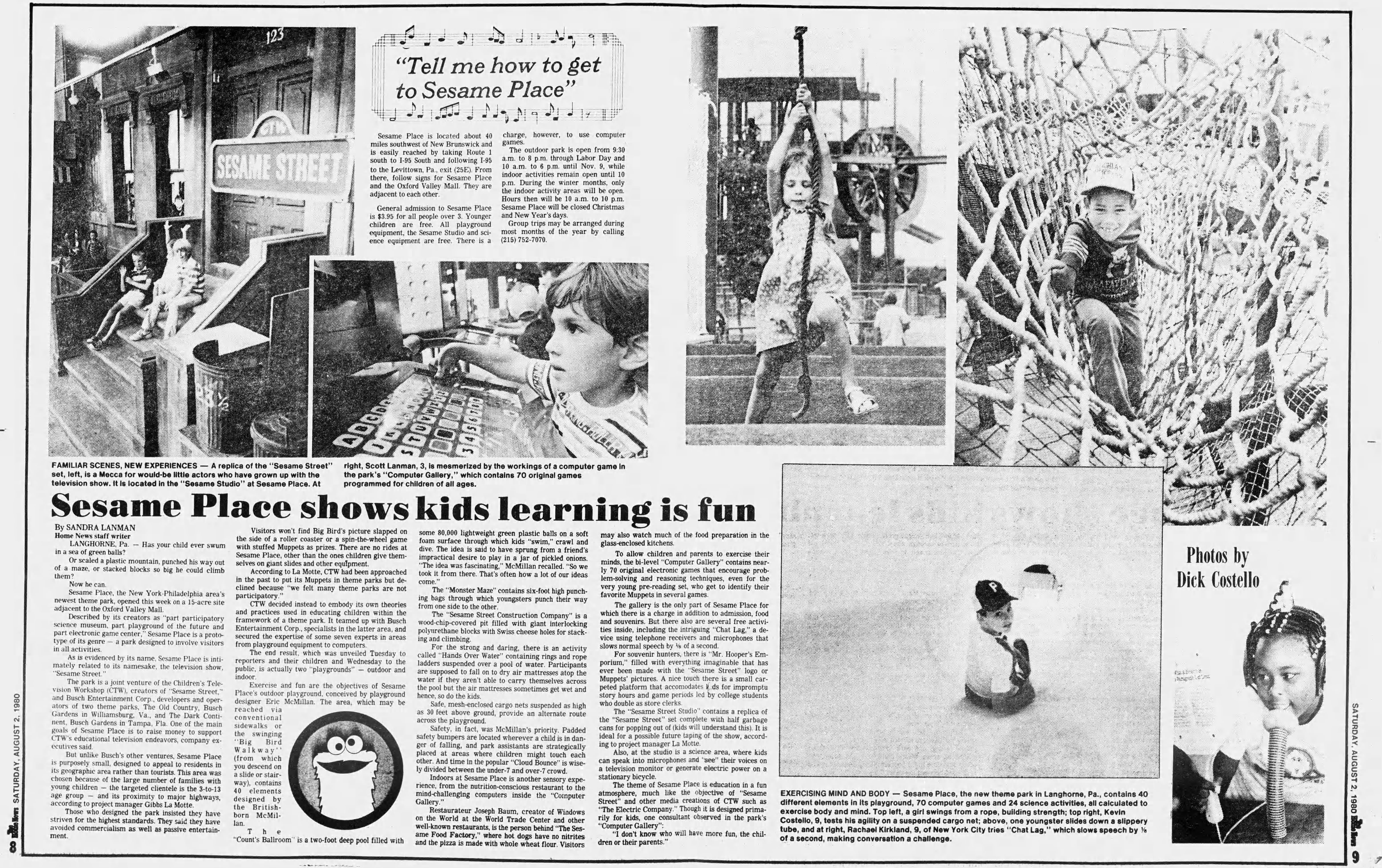
[Photo caption] FAMILIAR SCENES, NEW EXPERIENCES — A replica of the “Sesame Street” set, left, is a Mecca for would-be little actors who have grown up with the television show. It is located in the “Sesame Studio” at Sesame Place. At right, Scott Lanman, 3, is mesmerized by the workings of a computer game in the park's “Computer Gallery,” which contains 70 original games programmed for children of all ages.
[Photo caption] EXERCISING MIND AND BODY — Sesame Place, the new theme park in Langhorne, Pa., contains 40 different elements in its playground, 70 computer games and 24 science activities, all calculated to exercise body and mind. Top left, a girl swings from a rope, building strength; top right, Kevin Costello, 9, tests his agility on a suspended cargo net; above, one youngster slides down a slippery tube, and at right, Rachael Kirkland, 9, of New York City tries “Chat Lag,” which slows speech by � � of a second, making conversation a challenge.