The Guardian · London, Greater London, England · · Page 14
Video Gamesmanship
Transcript
NOLAN BUSHNELL knew from a very early age that he was going to be rich. His father, a cement contractor making sidewalks, and his mother, an ex-school teacher, told him over and over again that he could do anything he wanted just so long as he understood the sacrifices involved. Nolan Bushnell does not appear to have made many sacrifices. He merely acquired expensive tastes at a tender age and had to get used to finding ways of funding them. Today at 35 he is a multi-millionaire, the prize for being one of the first to spot the future of video computer games.
He knew, he says, that his money was going to be in technology. He was a radio ham at ten. "That equipment was really expensive. Five or six hundred dollars is a lot of money for someone of ten, so I had to figure out ways of finding it. I did so by working for my father and by buying army surplus stuff to sell to my friends at a profit."
Eventually the radio equipment was sold to pay for cars, and the cars sold to pay fees at the University of Utah where he studied engineering. In all he spent six years studying, course after course, anything and everything. He wanted to be Renaissance Man. "Those who prefer a derogatory interpretation say that such a man is Jack of all trades and master of none. I prefer to say that I'm Jack of all trades and master of one."
At college he appeared to be the master of money making. Early on he spotted another kid making a buck by producing a student calendar containing the term's events and surrounded by advertisements for the sort of services students, new to a town, need to know. The calendar was on sale for 50 cents. Bushnell immediately put the other kid out of business by devising a calendar blotter on the same principle, but which was given away.
"I wasn't concerned about whether the kids needed the blotter, so long as I could convince the merchants that they needed to buy advertising space. I got a total of 1,500 dollars for the ads, the printing cost was 200 dollars, and the rest was for me. I did this twice a year for three different universities.
"I then took another job in the evenings to stop me spending the money made from the ads. I went to work for an amusement arcade selling five balls for 25 cents to knock down milk bottles."
In the summer he worked in fun fairs too and with that money bought shares and played the stock market. He reckons that in all he made around 5,000 dollars a year. "That wasn't much. What you have got to understand is that I've always lived high I had a nice apartment, and drove a Mercedes 190 SL and mixed with a crowd of guys who were also busy movin' and shakin'." What? "Oh, that means making things happen We had nothing but scorn for the guys who had allowances and all the time in the world to study. We wanted to earn a better life style."
He finally got a degree at 26 and decided to try for "a big hit" in the engineering world which meant quitting Utah for a patch of California filled with electronic companies and fondly named Silicon Valley.
He got a job with an electronics company, but still could not forget the sums of money to be made from amusement arcades with which, after six years, he had become familiar. "At university we were allowed to play with the computer during the night. Playing with the computer, we became fascinated by the little electronic blobs which flashed around on the screen and we would turn them into missiles and rockets and play space races.
"Great fun, but at that time it didn't really occur to me that they could be used for games. After all the computer cost 10 million dollars, and at 25 cents a throw you couldn't expect to make money."
Then the American Space Programme took over and advance technology turned a 10 million dollar computer into a 10,000 dollar computer and Nolan Bushnell, busy in his new job working with computers, began to realise that he could make one at home for even less. He built the first one for 200 dollars.
Having made his computer at home, Bushnell took it to a small local manufacturer and said: "This is the greatest thing and I'm just off to Chicago with it, but I thought I'd let you have a quick look." The firm bought the idea and he quit his job and went to work for them making his computer space game. "After I joined I realised that it was a poorly managed firm, and that was why it was so small. After a year we had managed to sell a few games to amusement arcades and I went to them and said 'You are screwing up my project and I want a say in the marketing as well as an option on one-third of the company — or I'm leaving.' They told me to leave. They didn't understand the future of the video game."
So in 1972 Bushnell set up his own company. In the previous year he had been acquiring the odd pin-ball type machines and had been putting them into bars for a percentage of the takings, and now he stepped up this side of the operation to provide cash to make his video computer games. "I wanted to invent another game. Computer space was too complicated for the average man. My friends loved it, but they were all engineers. Men in bars were a bit mystified. So I looked around for a popular sport and at the time it was tennis so with my partner, Al Alcorn, we designed Pong."
Pong was a wild success. Within a year the little company had a staff of twenty and were making 100 units a day at $1,000 each.
By 1974 the company — called Atari, a Japanese word meaning "Watch out, I'm going to get you" — needed a great deal of cash to grow at the rate Bushnell wanted and so he sold out to Warner Communications for 28 million dollars. "I sought them out. I knew they were a creative, well-run company. I knew I couldn't work for any old dummy, and they have some people at least as good as me and some brilliant management." He is now chairman of Atari on a six figure salary plus a bonus programme.
He doesn't like talking about money. He was married once and has two kids somewhere whose pictures grace the walls of his office, and in these days of kidnapping, telling the world how rich you are is asking for trouble.
So what next? "Your working class person would love to go on safari, wouldn't he, but can't afford to. So what if I build a 20,000 square feet warehouse like a safari and charge a pound for a man to come in and shoot away at lions, and tigers. He'd have an experience as good as the real thing. You don't think so? Well, he'll have a pound's worth of fun, anyway.
"In this country we are not afraid to spend capital. In your country you get rid of scrappers, people who want to do things. There is no incentive. Some 30 per cent of my engineers are British. America is great because we do not try and oppress people who want to work. I'm sorry to be political, but why force a guy into mediocrity? If a guy wants to work 16 hours a day, then let him be paid well for it."
Nolan Bushnell no longer works the 100 hour week he did three or four years ago. He's down to between 30 and 40. "People should only work that hard in spurts and not be single faceted." Renaissance man wants time for his boat and skiing and his house with 20 rooms and time to think of other ideas. Like the Pizza Time Theatre?
"Ho.. do you know about that?" I told him I'd been talking to his secretary while he kept me waiting for an hour. "Well, it's an experiment we started last summer in San Jose. Americans already eat one in three meals outside their homes and I think this trend is going to continue, so Pizza Time Theatre is an eating place, with computer games, of course, and large singing animals, magpies singing soul, that sort of thing. The American public is becoming tired of TV, thank God. It is a real scourge. People watch it all the time and we are in danger of developing into a nation of dumb shits.
"Business is a great challenge. I always thought I'd be a professional student if I had enough money and the idea still appeals, but then so does making money."
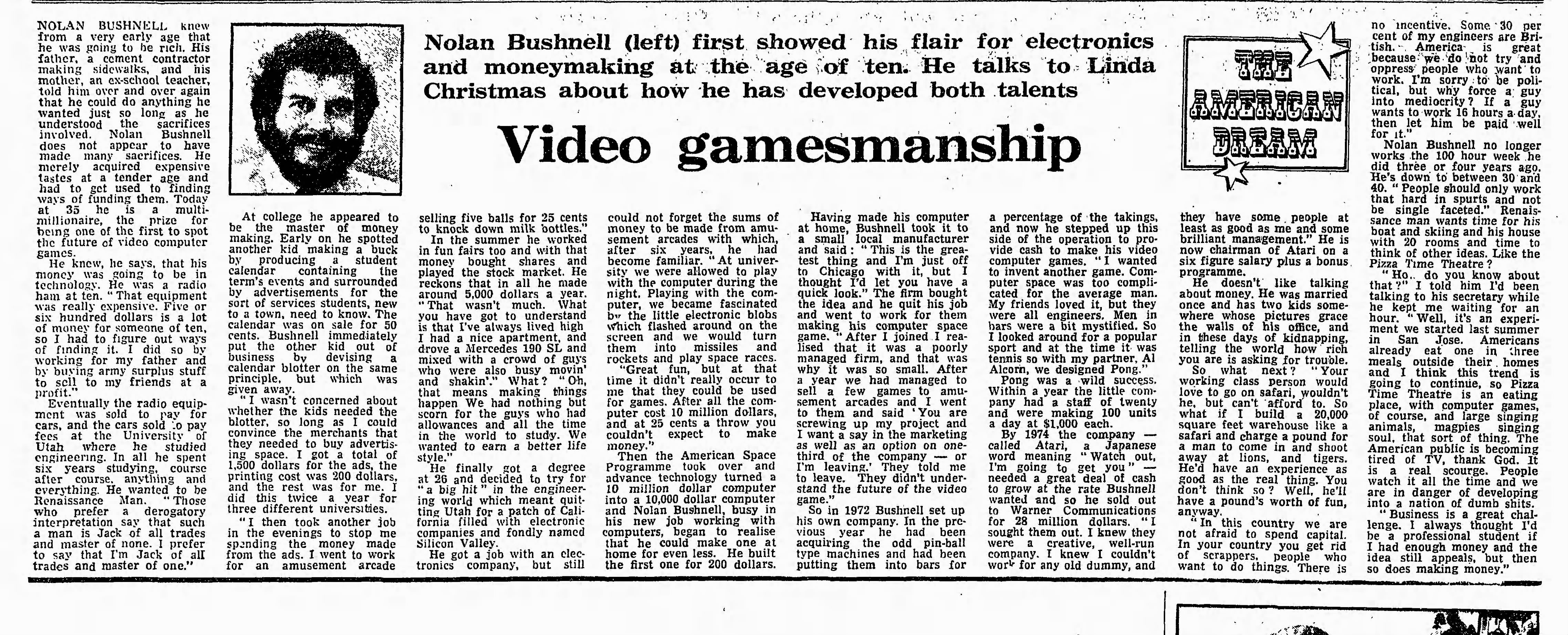
[Photo caption] Nolan Bushnell (left) first showed his flair for electronics and moneymaking at the age of ten. He talks to Linda Christmas about how he has developed both talents