The Orlando Sentinel · Orlando, Florida · · Page 55
Area's Inventors in World of Their Own
By Brad Kuhn, Of the Sentinel Staff
Transcript
commercial value.
Many first-time inventors envision a patent as some kind of magic ticket to wealth, patent lawyers said. But a patent usually has little to do with success, or failure.
“The best inventors are going to be the ones that combine that creative genius with some knowledge of the marketplace,” said Franz, who has been a patent lawyer since 1978. “Over the years, I've met different types — from the corporate type to the starry-eyed and the practical types, like Air [Fechter].
“Many inventors have pipe dreams. They have no way to get from point A to point B.”
Success may not be as sweet as many inventors envision it.
Billy Bob and Fatz made Fechter a millionaire by age 30. But it also made him lonely and bitter.
“The dream of becoming a millionaire is a lot more fun than being one,” Fechter said. “When you are striving for success, all of your friends are behind you cheering you on. But, man, when you make it, they hate you. They'll start tearing at your flesh.”
Having millions of dollars, however, has allowed him to create. He has installed an air-controlled sliding door to his bedroom that, he said, will respond to verbal commands such as “open sesame.” He also is putting in computer-controlled skylight covers that will accommodate his work-all-night-sleep-all-day lifestyle.
But in many ways, he said, life was more fun back in the late 1970s, when he lived in an apartment at his factory and everything was just getting started.
In three years he went from barely ekeing out a living hawking a Leaf Eater door to door to running a company — Creative Engineering — with monthly expenses of $500,000. By 1982, the company had 300 employees and an assembly line mass-producing Fatz and friends. ShowBiz was giving the company more research money than it could spend.
“I'd walk through the factory, and I'd see people I didn't know, people who worked for me,” he said.
“They'd complain that the person next to them was getting paid the same as them but was doing less work. If every one of those employees had just one problem a year, all my time would be spent on personnel issues. I hated that.”
Staff problems were only one headache. By 1983, the ShowBiz chain was struggling, and Fechter's personal life was in turmoil.
Stressed to the breaking point, Fechter said, he dropped out. He sold his stake in ShowBiz for several million dollars, bought a house, moved out of the office and went back to inventing.
Elmer hopes to avoid burnout by keeping his company small. He won't disclose his annual sales, but he said he has 15 employees and that is as big as he plans to get.
Fechter still owns the animation company, which now sells a scaled-down but more-sophisticated version of Fatz and company to other pizza chains — but not ShowBiz.
The company is profitable, he said, generating enough money to keep him from having to dip into savings. But for the past 10 years he has spent most of his energy on a top-secret project he calls AGFM. He won't reveal details of the invention publicly, although in private it's all he can talk about.
He has invested too much time, love and sweat to mess things up with public declarations, such as a patent.
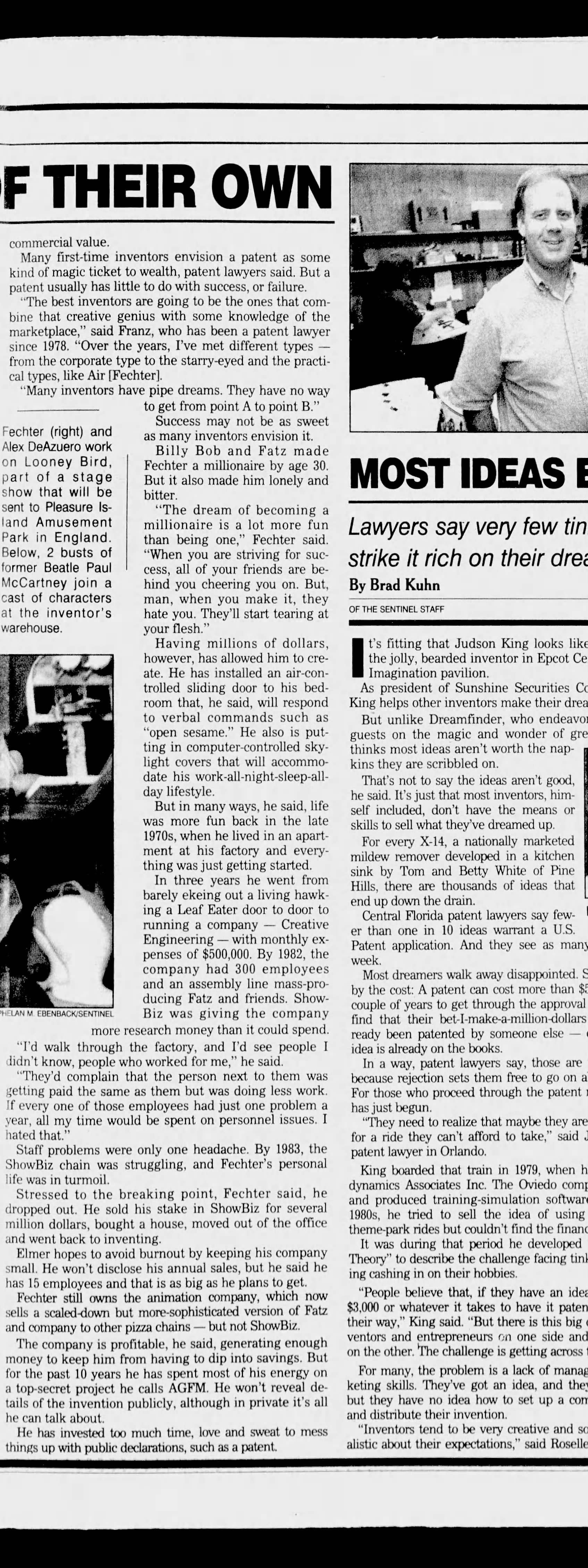
[Photo caption] Fechter (right) and Alex DeAzuero work on Looney Bird, part of a stage show that will be sent to Pleasure Island Amusement Park in England. Below, 2 busts of former Beatle Paul McCartney join a cast of characters at the inventor's warehouse.