The Bradenton Herald · Bradenton, Florida · · Page 49
Bradenton pizza parlors serve pies with a dash of electronic pizzazz
JOAN CHRISSOS, Herald Staff Writer
Transcript
To produce profits, add pizza, pizzazz, Pac-Man and performers.
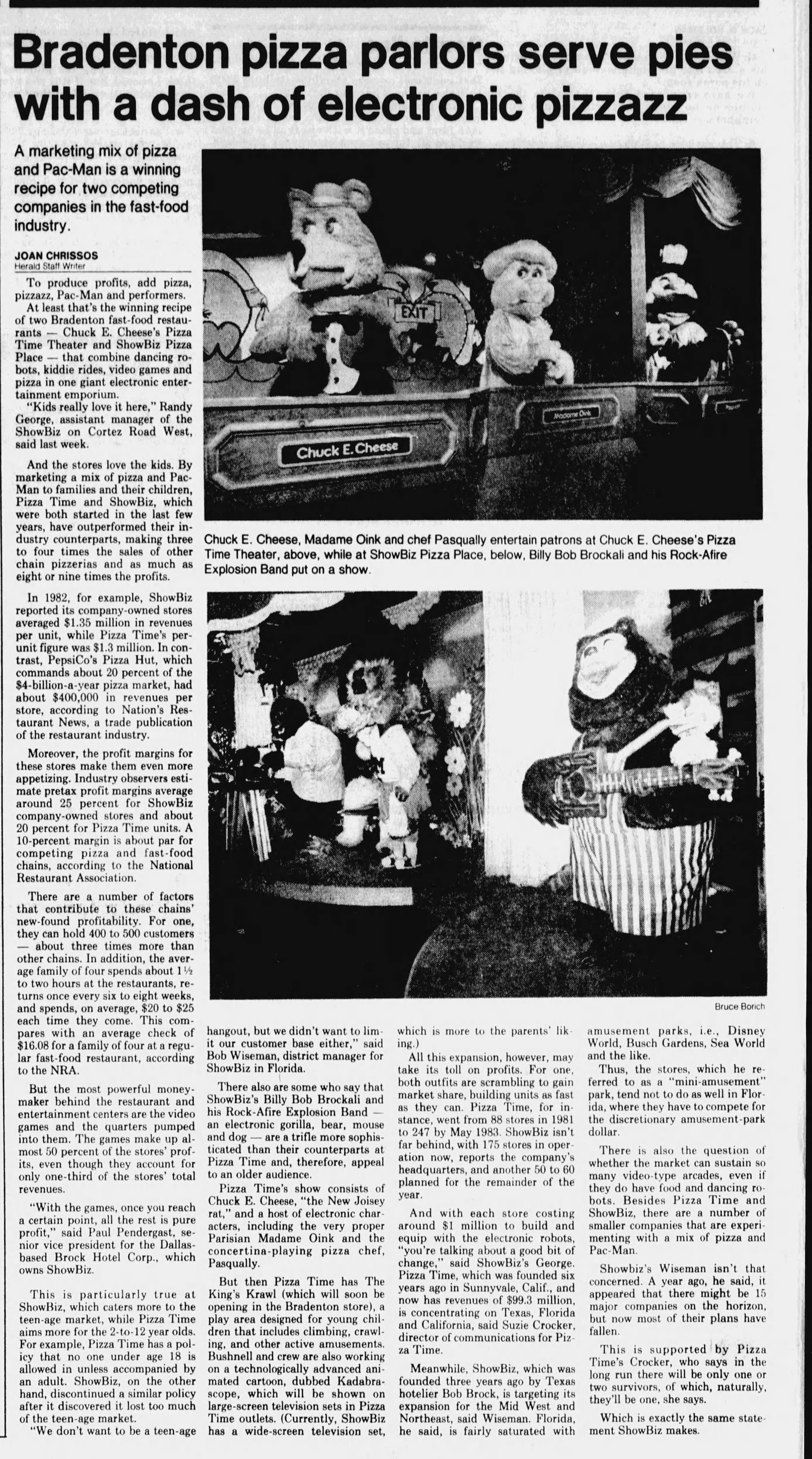
At least that's the winning recipe of two Bradenton fast-food restaurants — Chuck E. Cheese's Pizza Time Theater and ShowBiz Pizza Place — that combine dancing robots, kiddie rides, video games and pizza in one giant electronic entertainment emporium.
“Kids really love it here,” Randy George, assistant manager of the ShowBiz on Cortez Road West, said last week.
And the stores love the kids. By marketing a mix of pizza and Pac-Man to families and their children, Pizza Time and ShowBiz, which were both started in the last few years, have outperformed their industry counterparts, making three to four times the sales of other chain pizzerias and as much as eight or nine times the profits.
In 1982, for example, ShowBiz reported its company-owned stores averaged $1.35 million in revenues per unit, while Pizza Time's per-unit figure was $1.3 million. In contrast, PepsiCo's Pizza Hut, which commands about 20 percent of the $4-billion-a-year pizza market, had about $400,000 in revenues per store, according to Nation's Restaurant News, a trade publication of the restaurant industry.
Moreover, the profit margins for these stores make them even more appetizing. Industry observers estimate pretax profit margins average around 25 percent for ShowBiz company-owned stores and about 20 percent for Pizza Time units. A 10-percent margin is about par for competing pizza and fast-food chains, according to the National Restaurant Association.
There are a number of factors that contribute to these chains' new-found profitability. For one, they can hold 400 to 500 customers — about three times more than other chains. In addition, the average family of four spends about 1½ to two hours at the restaurants, returns once every six to eight weeks, and spends, on average, $20 to $25 each time they come. This compares with an average check of $16.08 for a family of four at a regular fast-food restaurant, according to the NRA.
But the most powerful money-maker behind the restaurant and entertainment centers are the video games and the quarters pumped into them. The games make up almost 50 percent of the stores' profits, even though they account for only one-third of the stores' total revenues.
“With the games, once you reach a certain point, all the rest is pure profit,” said Paul Pendergast, senior vice president for the Dallas-based Brock Hotel Corp., which owns ShowBiz.
This is particularly true at ShowBiz, which caters more to the teen-age market, while Pizza Time aims more for the 2-to-12 year olds. For example, Pizza Time has a policy that no one under age 18 is allowed in unless accompanied by an adult. ShowBiz, on the other hand, discontinued a similar policy after it discovered it lost too much of the teen-age market.
“We don't want to be a teen-age hangout, but we didn't want to limit our customer base either,” said Bob Wiseman, district manager for ShowBiz in Florida.
There also are some who say that ShowBiz's Billy Bob Brockali and his Rock-Afire Explosion Band — an electronic gorilla, bear, mouse and dog — are a trifle more sophisticated than their counterparts at Pizza Time and, therefore, appeal to an older audience.
Pizza Time's show consists of Chuck E. Cheese, “the New Joisey rat,” and a host of electronic characters, including the very proper Parisian Madame Oink and the concertina-playing pizza chef, Pasqually.
But then Pizza Time has The King's Krawl (which will soon be opening in the Bradenton store), a play area designed for young children that includes climbing, crawling, and other active amusements. Bushnell and crew are also working on a technologically advanced animated cartoon, dubbed Kadabrascope, which will be shown on large-screen television sets in Pizza Time outlets. (Currently, ShowBiz has a wide-screen television set, which is more to the parents' liking.)
All this expansion, however, may take its toll on profits. For one, both outfits are scrambling to gain market share, building units as fast as they can. Pizza Time, for instance, went from 88 stores in 1981 to 247 by May 1983. ShowBiz isn't far behind, with 175 stores in operation now, reports the company's headquarters, and another 50 to 60 planned for the remainder of the year.
And with each store costing around $1 million to build and equip with the electronic robots, “you're talking about a good bit of change,” said ShowBiz's George. Pizza Time, which was founded six years ago in Sunnyvale, Calif., and now has revenues of $99.3 million, is concentrating on Texas, Florida and California, said Suzie Crocker, director of communications for Pizza Time.
Meanwhile, ShowBiz, which was founded three years ago by Texas hotelier Bob Brock, is targeting its expansion for the Mid West and Northeast, said Wiseman. Florida, he said, is fairly saturated with amusement parks, i.e., Disney World, Busch Gardens, Sea World and the like.
Thus, the stores, which he referred to as a “mini-amusement” park, tend not to do as well in Florida, where they have to compete for the discretionary amusement-park dollar.
There is also the question of whether the market can sustain so many video-type arcades, even if they do have food and dancing robots. Besides Pizza Time and ShowBiz, there are a number of smaller companies that are experimenting with a mix of pizza and Pac-Man.
Showbiz's Wiseman isn't that concerned. A year ago, he said, it appeared that there might be 15 major companies on the horizon, but now most of their plans have fallen.
This is supported by Pizza Time's Crocker, who says in the long run there will be only one or two survivors, of which, naturally, they'll be one, she says.
Which is exactly the same statement ShowBiz makes.
[Photo caption] Chuck E. Cheese, Madame Oink and chef Pasqually entertain patrons at Chuck E. Cheese's Pizza Time Theater, above, while at ShowBiz Pizza Place, below, Billy Bob Brockali and his Rock-Afire Explosion Band put on a show. Bruce Borich