Mintmarks are the small letters or symbols struck onto a token by the company that physically made it. On collector tokens like the ones in this catalog, mintmarks identify the manufacturer (sometimes called the "minter"), not the issuing brand. Knowing the mintmark vocabulary is one of the fastest ways to spot variants and date a piece more precisely than the design alone allows.
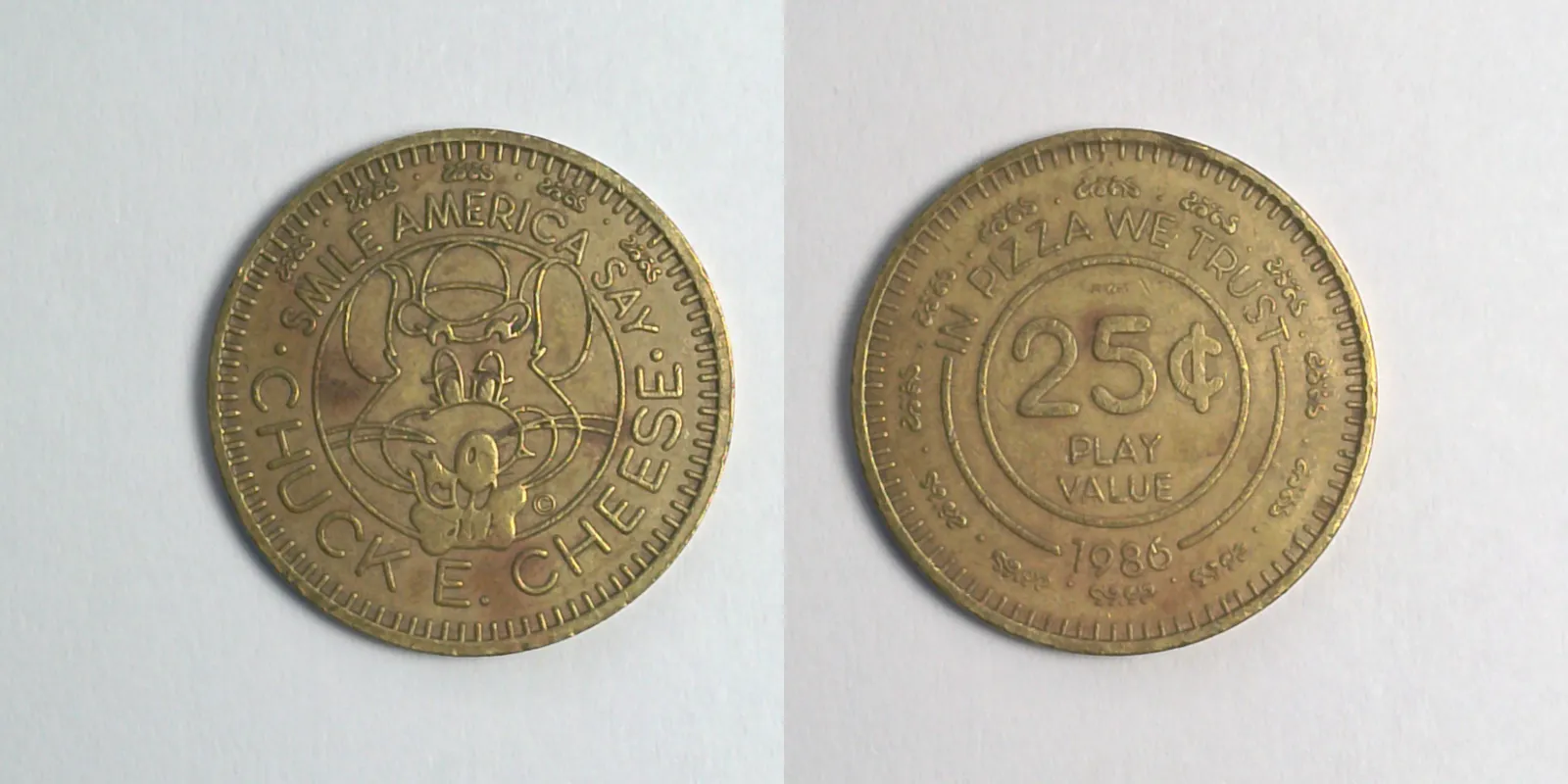
Where mintmarks appear
Mintmarks on Chuck E. Cheese, Showbiz Pizza, and related-brand tokens are usually:
- A few small letters (often two or three characters)
- Tucked near the rim or in a quiet corner of the design
- Sometimes on the reverse, often near the base of the central design
You'll need decent lighting and sometimes a loupe (or a phone camera with macro zoom) to read them on circulated pieces.
The major mintmarks
RWM, Roger Williams Mint
The most prominent mintmark in this catalog. Roger Williams Mint, based in Rhode Island, struck the bulk of the Chuck E. Cheese and Showbiz Pizza tokens over the decades. RWM also produced tokens for Peter Piper, Discovery Zone, and a long list of related operators.
When you see RWM on the obverse or reverse, you're holding a Roger Williams Mint piece. The mintmark is consistent across decades; the same two letters appear on tokens struck thirty years apart.
Roger Williams Mint also produced the "No Cash Value" prototype tokens that show up as catalog rarities. Those pieces are essentially manufacturer samples that never went into regular circulation.
HH and HM, Hoffman & Hoffman / Hoffman Mint
These two mintmarks belong to the same company. HH is the mark of Hoffman & Hoffman. Around 1999 the company changed its name to Hoffman Mint and switched to the HM mintmark. The two marks therefore identify the same manufacturer at different points in time: HH on earlier pieces, HM on pieces struck after the late-1990s name change.
Because dies get reused, the switch wasn't instant. Existing dies kept their HH mintmark and stayed in service after 1999, while dies cut from then on carried HM. A few tokens even show HH on one side and HM on the other, transitional pieces struck from one older die and one newer one. New HH dies, though, stopped being made after roughly 1999.
That gives these marks real dating value: HH points to earlier production, HM to later (post-1999) production, and a mixed HH/HM piece to the transition around the name change.
Hoffman's marks turn up on Peter Piper Pizza tokens (especially the Type 1 era) and on a smaller subset of Showbiz Pizza Place pieces. As with any mintmark, an otherwise-identical design struck with HH versus HM is a distinct catalog row, so the mark is worth checking when you're tracking variants.
OC
Appears on some Chuck E. Cheese tokens. OC pieces are less common than RWM and are a notable variant for completionist collectors.
How mintmarks create variants
A single design can spawn multiple catalog entries based on mintmark presence, mintmark position, or mintmark absence:
- Same design, different mintmark is a distinct catalog row.
- Same design, same mintmark, different position (front vs back, top vs bottom) is also a distinct row in many cases.
- Same design, mintmark absent is yet another row. Some early-run pieces were struck before the mint added its mark, or with the mark suppressed for the issuing operator.
The cectoken catalog encodes these distinctions in the catalog code. Two tokens with codes like 101B and 101B (variant) might differ only in mintmark presence.
A common variant trap: the "RWM under E"
Showbiz Pizza Type 2 reverses include a small "Play Value" text. Some catalog variants have the RWM mintmark positioned under the E in "Value"; others have it elsewhere. These are different catalog entries with different rarity ratings, and the only way to distinguish them is by looking closely at the reverse.
This kind of micro-positioning trap is common across the catalog. When two listings look identical at first glance, check the mintmark position before assuming they're the same piece.
What mintmarks don't tell you
A mintmark identifies the manufacturer, not:
- The year struck. Roger Williams Mint produced tokens from the 1970s to the present; "RWM" on a token narrows nothing about vintage by itself. (Hoffman's HH and HM marks are a partial exception: the switch from HH to HM happened around 1999. See the HH and HM section above.)
- The original issuing location. The brand on the front of the token tells you where it was used. The mintmark only tells you where it was made.
The quick check
When you're looking at a token and trying to read its mintmark:
- Use angled light. Mintmarks are typically struck shallow. They show up best when light hits the token at an angle rather than head-on.
- Check both sides. Mintmarks are not always on the obverse.
- Check the base of the central design. That's the most common location across the catalog.
- Use a loupe or phone macro. Mintmarks can be smaller than the surrounding lettering.
- Compare to a known-mintmark example on the relevant catalog item page if you're uncertain.
Where to go next
- Identifying composition by sight covers the metal-identification half of token evaluation.
- Coin vs medal orientation covers another small detail that creates distinct catalog variants.