Most arcade tokens are brass. That's the default, the workhorse, the "if you don't know what you have, it's probably this" composition. But the catalog tracks several other metals and finishes, and recognizing each one by sight is a basic collector skill. This guide covers the major compositions and what they look like in hand.
Brass
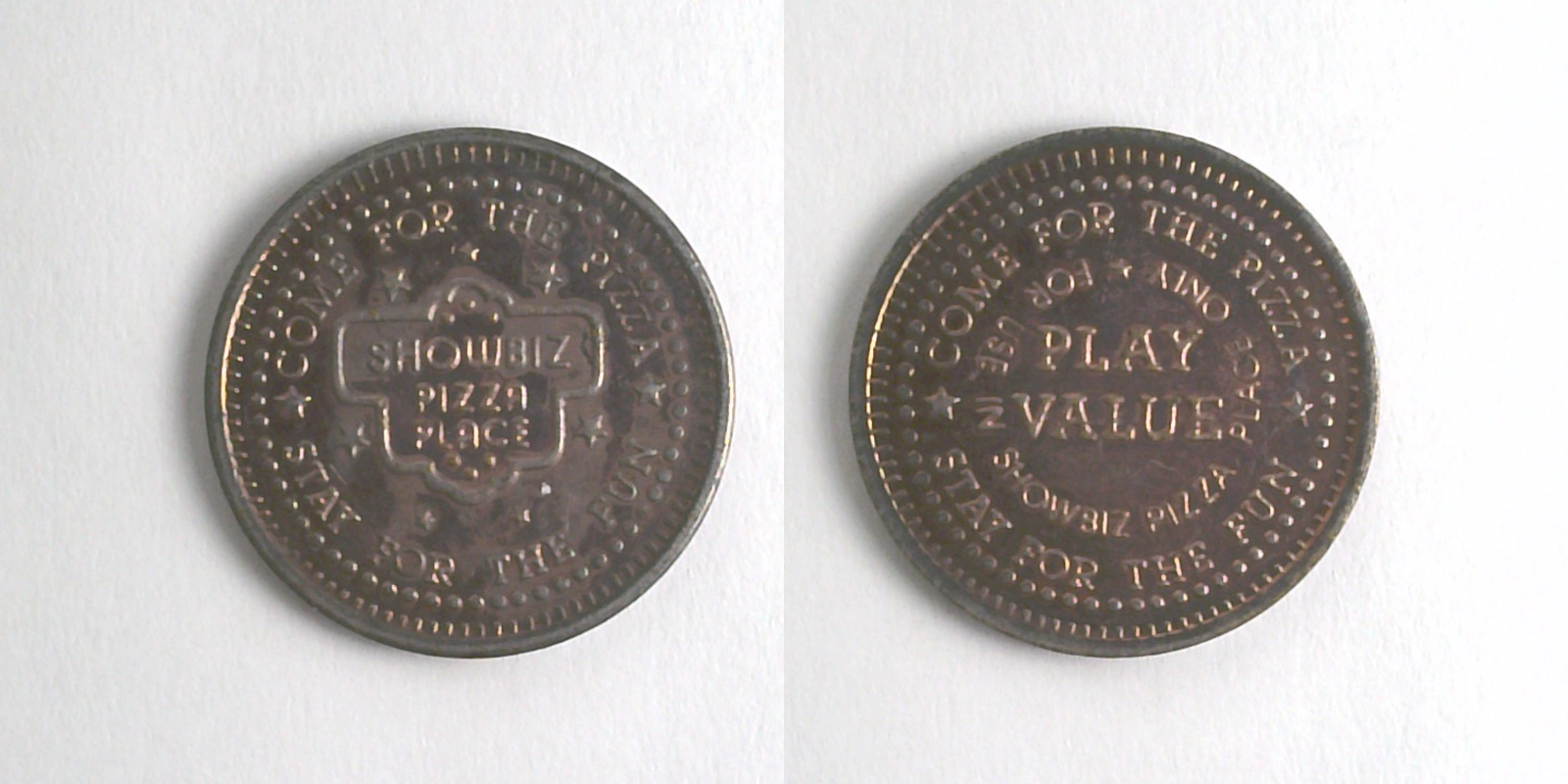
By far the most common composition across 914 catalog items. Brass is a copper-zinc alloy, typically with a slight golden-orange color when fresh and a deeper bronze patina when aged. Almost every issued play token across Chuck E. Cheese, Showbiz Pizza, Peter Piper, and the long tail of related chains was struck in brass at some point.
Visual cues:
- Warm golden-orange tone when clean, deeper bronze when aged
- Patina forms quickly with handling; older brass tokens often look almost copper-colored on the surface
- Slightly heavier and softer than nickel; the rim and high points of the design wear easily
Catalog suffix: B (e.g., 101B, S02B, PP201B)
Nickel (or nickel-plated brass)
The second most common composition. Most "nickel" tokens in the catalog are actually brass cores with a nickel plating, not solid nickel. The plating gives the silvery-white appearance and rings differently than a solid-nickel piece, but for grading and collecting purposes the catalog treats them as one category.
Visual cues:
- Silvery-white surface, similar to a US dime or quarter
- Plated pieces can show brass through worn high points (a small orange dot on the top of Chuck's head, for example)
- Less prone to patina than brass; surfaces stay bright longer
Catalog suffix: N (e.g., 101N, S05N, PP202N)
Copper
A distinctive reddish-orange color, much warmer than brass and more saturated. Copper tokens are scarce compared to brass and nickel issues; they show up most often as control tokens or limited-run pieces.
Visual cues:
- Reddish-orange when clean; develops a darker brown patina with age
- Heavier feel than nickel; slightly softer than brass
- Bright examples almost glow under good light
Catalog suffix: C (e.g., S08C, S11C, P405C)
Anodized nickel (the color variants)
The most visually distinctive composition family. Anodized nickel tokens take on a saturated color from an electrochemical surface treatment: the catalog includes pink, blue (in light, medium, and dark variants), olive green, red, and black anodized pieces. The Showbiz Pizza Type 2 series has the most diverse anodized palette.
Visual cues:
- Saturated, uniform color across the entire surface
- The color sits in the surface of the metal, not on top of it; light reveals subtle metallic depth
- Edges and high points may show the underlying nickel where the anodization has worn
Catalog suffix: aN with a color qualifier (e.g., S09aN-pink, S09aN-blue, M03aA-gold for an anodized aluminum variant)
Anodized aluminum
A few medals and special-purpose tokens are anodized aluminum rather than anodized nickel. The visual effect is similar, but aluminum is noticeably lighter in hand than nickel or brass, and the metal underneath is silvery-white rather than the warmer tone of nickel.
Catalog suffix: aA (often with a color qualifier)
Painted brass
Some control tokens and limited-run promotional pieces were brass coated with paint or chemical color treatments. Unlike anodization, which infuses color into the metal surface, paint sits on top and can chip off with handling. The Chuck E. Cheese M04pB franchise convention medal comes in painted brass variants (orange, pink, white).
Visual cues:
- Glossy or matte color layer over the brass substrate
- Chipping or wear can reveal brass underneath at corners or edges
Catalog suffix: pB (e.g., M04pB-orange)
Wood
A small number of promotional pieces were struck (or printed) on wood. The early Chuck E. Cheese P02W, P03W, and P04W promotional tokens are the headline examples. Wood pieces are dramatically rarer than metal because they were typically meant to be redeemed and destroyed.
Visual cues:
- Obvious wood grain
- Light brown or tan color depending on the wood type and any tinting
- Significantly lighter in hand than any metal token
Catalog suffix: W (e.g., P02W, P04W)
Plastic
Used for some promotional pieces, prize medals, and modern handouts. The Chuck E. Cheese P05P-yellow promotional and the M05P through M10P prize medals are plastic.
Visual cues:
- Synthetic feel, often lighter or differently weighted than metal
- Color is typically vivid and uniform (red, gold, silver, yellow)
- Can be transparent or opaque
Catalog suffix: P (e.g., P05P-yellow, M08P-gold)
The quick-check protocol
When you have a token in hand and you're not sure what it is:
- Color first. Golden-orange = brass. Silvery-white = nickel. Reddish-orange = copper. Any saturated non-natural color = anodized or painted.
- Weight second. Anodized aluminum and plastic feel noticeably lighter than brass or nickel.
- Check the high points. If you can see a different color under wear, you have a plating (most often nickel over brass).
- Check the catalog suffix. Every catalog code ends with a composition letter, and the full naming scheme is in the Compositions, Sizes, and Terms guide.
Where to go next
- Mintmarks across the chains covers the small letters telling you who struck the token.