Orientation" in token collecting refers to how the front and back of a coin or token line up when you flip the piece. It's a small detail that creates distinct catalog variants and tells you something about how the token was struck.
Coin orientation
Hold a US quarter face-up, then flip it from the top edge (north-to-south). The eagle on the back appears upside down. That's coin orientation, also called "die rotation" or "180-degree rotation."
In coin orientation, the front and back dies are aligned with their tops pointing in opposite directions. You flip the piece end-over-end and one side is right-side-up, the other is upside-down.
Coin orientation is the default for US currency. It's also used on a meaningful share of the tokens in this catalog, especially older pieces.
Medal orientation
Hold a commemorative medal face-up, then flip it from the top edge. The back appears right-side-up too. That's medal orientation.
In medal orientation, both dies have their tops pointing the same direction. You flip the piece and both sides read normally without rotating.
Medal orientation is standard for commemorative pieces (anything not meant for circulation as money), including most modern arcade tokens and all of the CEC commemorative medals (M01N, M02B, M04pB, and the rest).
How to tell
For any token you own:
- Hold it face-up with the design oriented correctly.
- Flip it from top to bottom (north-to-south, like turning a page).
- Look at the reverse.
- Reverse is right-side-up: medal orientation.
- Reverse is upside-down: coin orientation.
You can do the same test by flipping side-to-side (east-to-west), with reversed results: medal orientation will look upside-down when flipped sideways, coin orientation will look right-side-up.
A side-by-side example
One coin-orientation token and one medal-orientation token, both Chuck E. Cheese pieces:
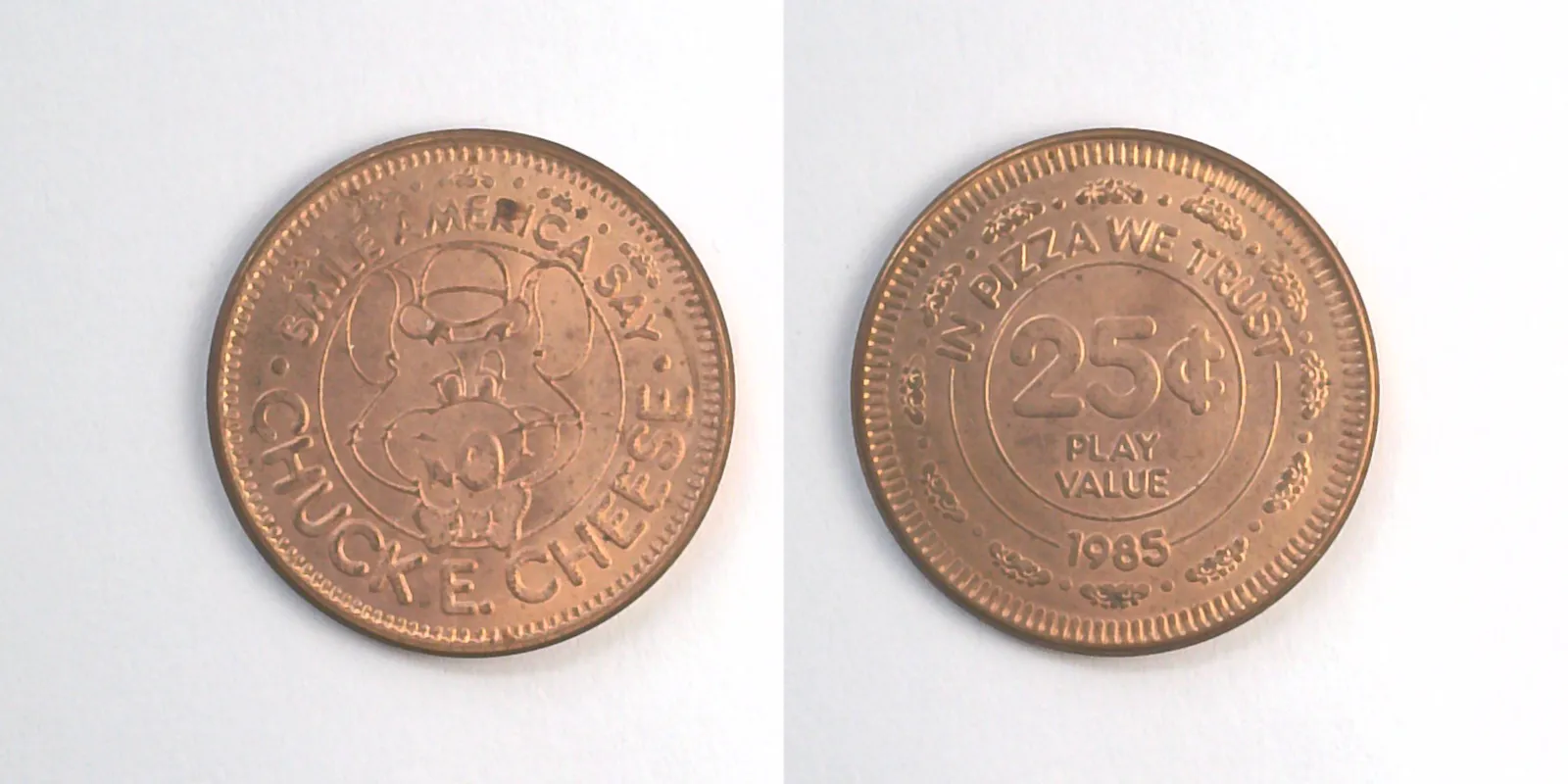
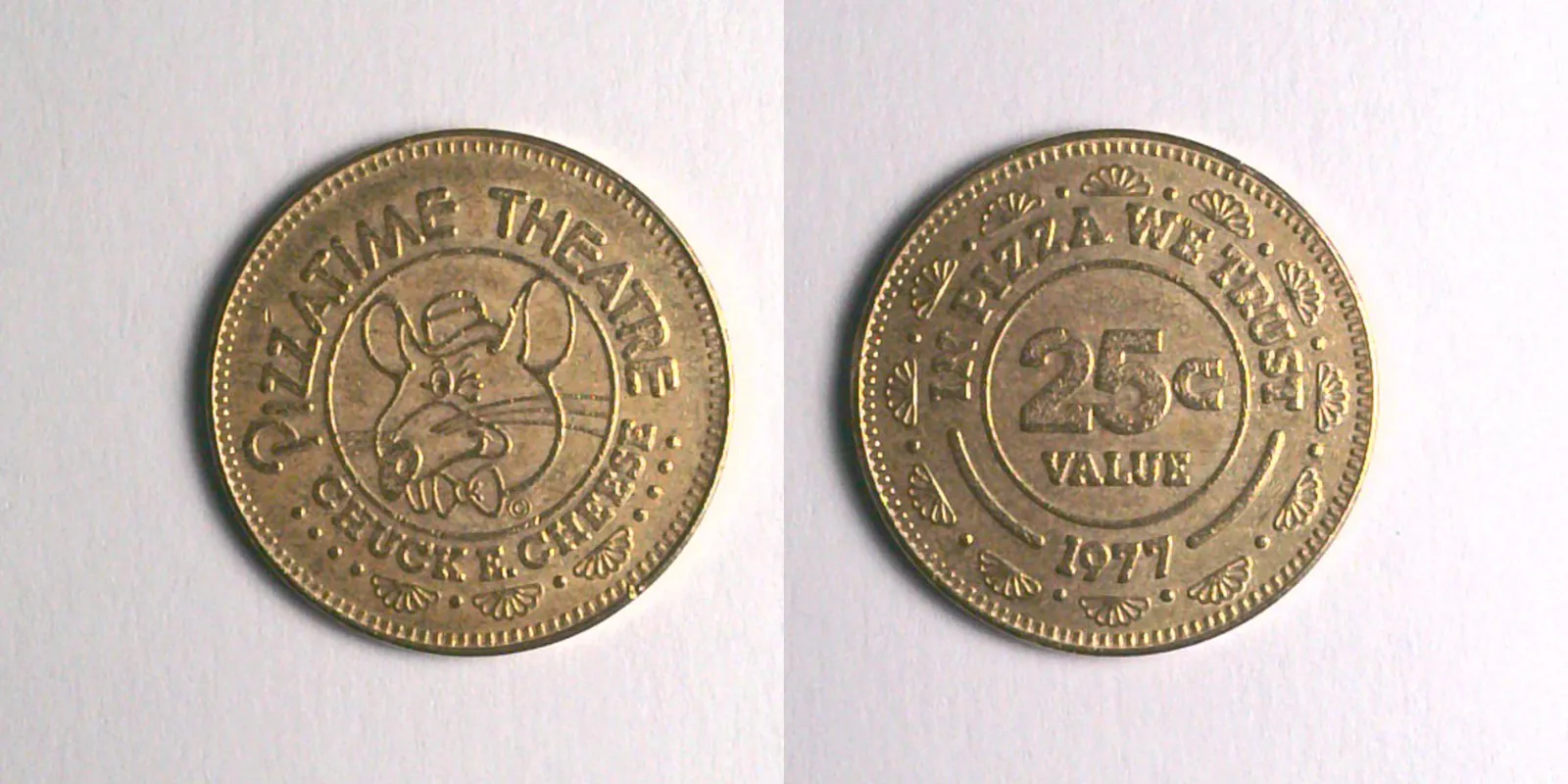
Why it matters for catalog variants
The cectoken catalog distinguishes between coin and medal orientations as separate catalog entries when the same design exists in both. Two tokens that look completely identical can be different catalog rows because one is struck in coin orientation and the other in medal orientation.
A few notable examples across the catalog:
- Showbiz Pizza Place Type 2 tokens exist in both orientations across multiple catalog codes.
- Peter Piper Type 2 "Rocky" pieces include both orientations within the same series.
- Discovery Zone tokens vary by orientation across their three types.
When buying or trading, always specify orientation if it's a token that has both variants. "S02B in medal orientation" is a different request than "S02B in coin orientation."
What it tells you about how a token was struck
The orientation is set when the dies are mounted in the coining press. Coin orientation requires one die to be rotated 180 degrees relative to the other. Medal orientation has both dies in the same rotational alignment.
Switching between orientations is a die-installation choice. A run of tokens produced from the same dies installed differently will read differently when flipped, even though the obverse and reverse designs are unchanged.
For collectors, this means orientation is a manufacturing signal:
- A run of identical-orientation pieces likely came from a single die-installation session.
- A mid-run orientation flip suggests the dies were re-installed (for maintenance, replacement, or other operational reasons).
- Orientation variants alongside design variants help reconstruct the production timeline of a series.
Where the catalog notes it
Every item detail page on cectoken.com shows the orientation in the specifications block as either "Coin" or "Medal." If you don't see it called out explicitly, check the catalog code: some catalog suffixes encode orientation directly, though the visible badge on the item page is the authoritative source.
For a refresher on every spec block field, see Reading an item page.
Where to go next
- Mintmarks across the chains covers another small detail that creates distinct catalog variants.
- Reading catalog codes explains the cectoken.com numbering system, including how variant suffixes work.