Chuck E. Cheese issued tokens to customers to play arcade games. Typically, tokens were sold at $0.25 per token, and one token usually meant one play, at least in the classic “quarter arcade” era. As time went on (and prices did what prices do), the cost per play often climbed beyond a single token, but the token itself stayed a core part of the Chuck E. Cheese experience for decades.
Around 2018, Chuck E. Cheese aggressively shifted stores to Play Pass swipe cards and phased out tokens in most locations. Tokens still pop up in the wild at some stores and in some machines (especially anything mechanical that was built to eat tokens), but in general the token era is now more “collector history” than “weekly routine.” This catalog currently tracks 419 Chuck E. Cheese tokens, with the most recent vintage landing at 2025.
At a high level, Chuck E. Cheese tokens can be grouped into five main design types, basically matching the big mascot/branding eras. (Type 1 is split into two sub-types because one version is “generic” and the other version adds a city.)
Old Chuck E. Cheese, in Your Hand
If you searched for "old Chuck E. Cheese," you probably remember the original restaurant: the Pizza Time Theatre stage, the animatronic band, and the way the place looked in the 1980s and 1990s. Most of that is gone now. The original animatronics were pulled from all but a handful of locations by the end of 2024, and the old stores have been remodeled away.
The tokens are what survived. An old Chuck E. Cheese token is the most tangible piece of the original era you can still hold: the same brass, the same stamped year, and the same "In Pizza We Trust" the first generation of kids carried in their pockets. The oldest pieces in this catalog reach back to the Pizza Time Theatre debut in 1977, and this catalog now tracks 419 of them.
For the full story of the original chain, see the history of old Chuck E. Cheese and ShowBiz Pizza. For a deep dive on the oldest tokens of all, see the Rat Heads era guide.
Compositions and “Control Tokens”
Tokens come in several metal compositions. The most common is brass, which is the classic “arcade token look” most people recognize.
Then there are control tokens,tokens used by staff or technicians to test games and mechanisms, and then removed from circulation so they wouldn’t be counted as revenue. Early on, this often meant spray-painted brass tokens (low-tech, high effectiveness). Later, control-token needs (and operational quirks) are a big reason you’ll find much rarer compositions and finishes like copper, nickel, anodized finishes, and black chromate brass. These are substantially rarer than normal brass circulation tokens.
The Five Token Types
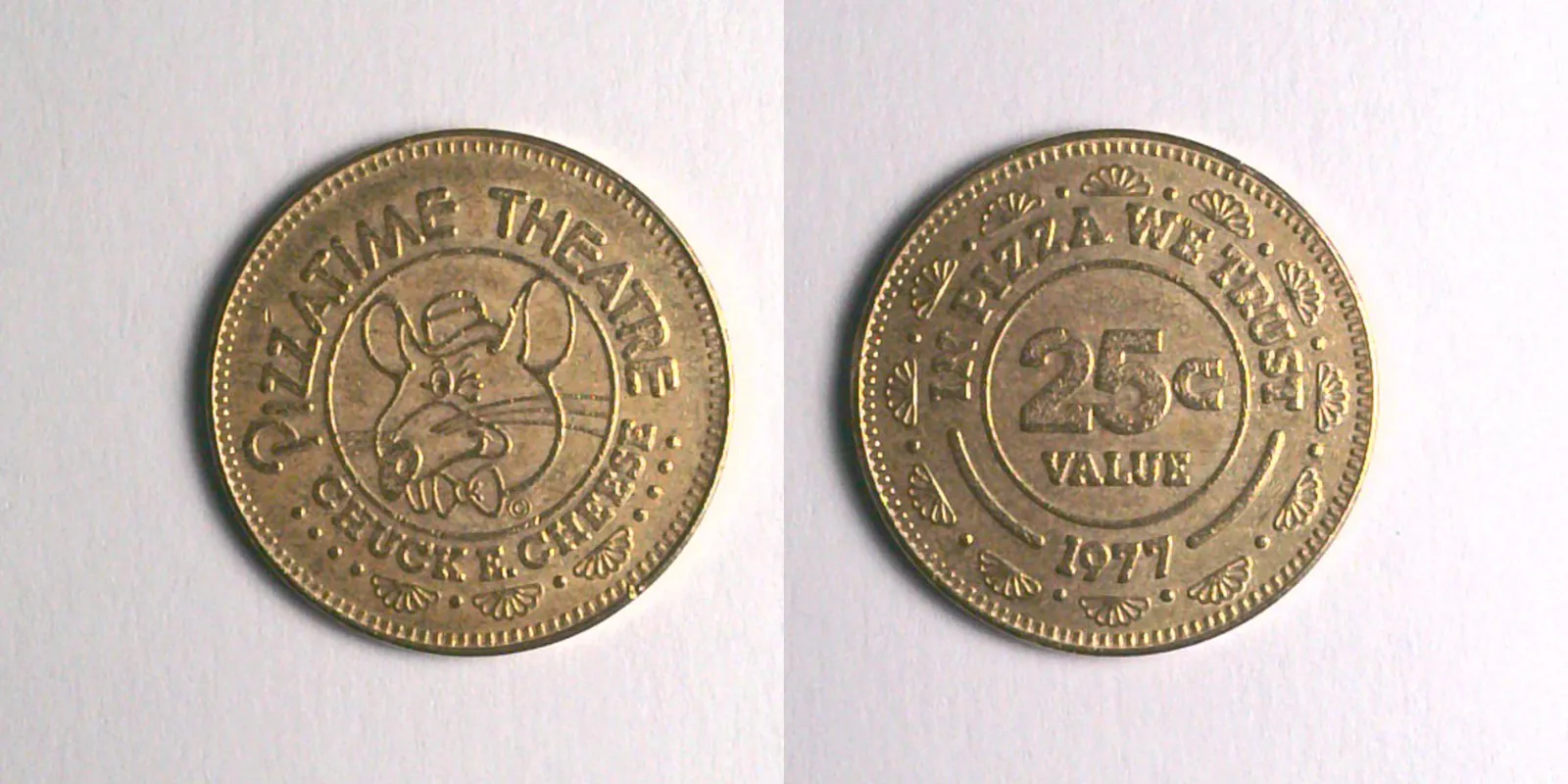
Type 1a: Rat Heads (1977–1982)
This is the true early-era stuff: the Pizza Time Theatre years.
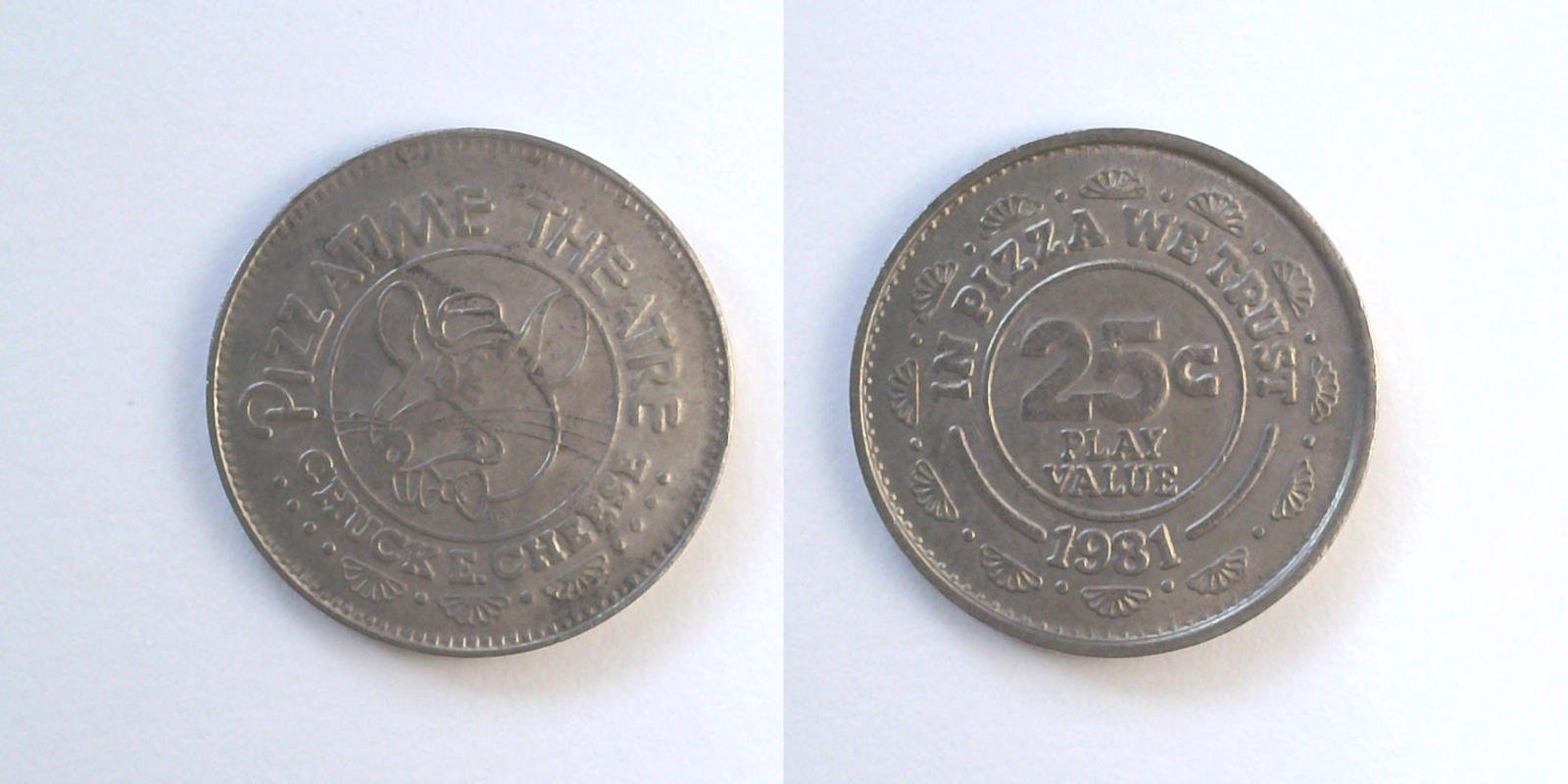
Front: The token shows the classic Pizza Time Theatre-era Chuck, with “Pizza Time Theatre” across the top and “Chuck E. Cheese” along the bottom. There are variations where “Pizzatime” is written as one word, and others where “Chuck E. Cheese’s” includes the apostrophe-S. Version control was not their strong suit in the early days.
Back: The center text reads “25c Value” or “25c Play Value” (you’ll see multiple fonts), with “In Pizza We Trust” above and the vintage year below.
Type 1b: City Tokens (1978–1983)
These are basically Rat Heads… with local flavor.
City tokens were issued as a franchise-era incentive and promotional concept to help attract operators to open locations in new markets. There are 44 different cities, and some cities have more than one token (different years or slightly different text).
Front: Same overall Rat Head / Pizza Time Theatre design as Type 1a, but with the city and state on the bottom.
Back: Same core layout as Type 1a: “In Pizza We Trust” above, the vintage year below, and the center text is usually “25c Value”, “25c Play Value”, or “25c Play.”
[Item not found: 1978-chuck-e-cheese-token-125b]
[Item not found: 1980-chuck-e-cheese-token-139n]
| City (full name) | State / Province | Exact Text |
|---|---|---|
| Arlington | Texas | Arlington, TX |
| Blaine | Minnesota | Blaine, MN |
| Burlington | Ontario | Burlington Ontario |
| Burnsville | Minnesota | Burnsville, MN |
| Citrus Heights | California | Citrus Heights, CA |
| Clearwater | Florida | Clearwater, FL |
| Concord | California | Concord, CA |
| Fort Myers | Florida | Ft Myers, FL |
| Fremont | California | Fremont, CA |
| Fresno | California | Fresno, CA |
| Fullerton | California | Fullerton, CA |
| Garden Grove | California | Garden Grove, CA |
| Hayward | California | Hayward, CA |
| Huntington Beach | California | Huntington Beach, CA |
| Jacksonville | Florida | Jacksonville, FL |
| Kansas City | Missouri | Kansas City |
| Lake Forest | California | Lake Forrest, CA |
| Long Beach | California | Long Beach, CA |
| Maple Heights | Ohio | Maple Heights, Ohio |
| Maplewood | Minnesota | Maplewood, MN |
| Memphis | Tennessee | Memphis, TN |
| Mobile | Alabama | Mobile, Ala |
| Modesto | California | Modesto, CA |
| New Hope | Minnesota | New Hope, Minn |
| Ogden | Utah | Ogden, UT |
| Pinole | California | Pinole, CA |
| Raleigh | North Carolina | Raleigh, NC |
| Reno | Nevada | Reno, Nevada |
| Reno–Sparks | Nevada | Reno-Sparks, NV |
| Sacramento | California | Sacramento, CA |
| Salt Lake City | Utah | Salt Lake City Utah |
| San Diego | California | San Diego, CA |
| San Jose | California | San Jose, CA |
| San Ramon | California | San Ramon, CA |
| Santa Ana | California | Santa Anna, CA |
| Santa Rosa | California | Santa Rosa, CA |
| Simi Valley | California | Simi Valley, CA |
| Somewhere | Delicious | HAV PIZZA |
| Stockton | California | Stockton, CA |
| Sunnyvale | California | Sunnyvale, CA |
| Tucson | Arizona | Tuscon, Ariz |
| Westland | Michigan | Westland, Mich |
| Westminster | Colorado | Westminster, CO |
| Winter Park | Florida | Winterpark, FL |
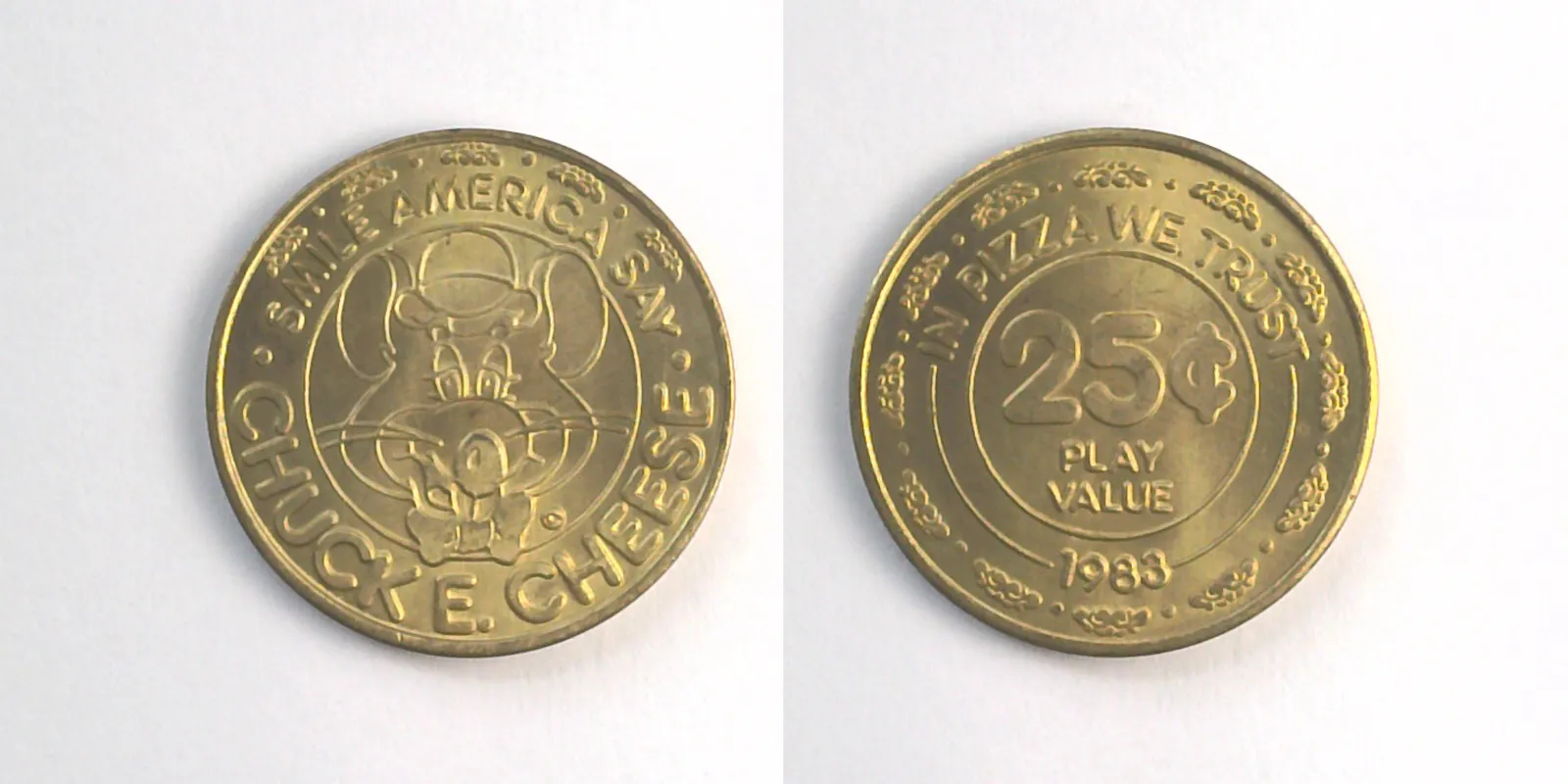
Type 2: Tux Chucks (1983–1990)
This is the first big “new era” redesign, swapping the Pizza Time Theatre vibe for something more brand-polished: Tuxedo Chuck.
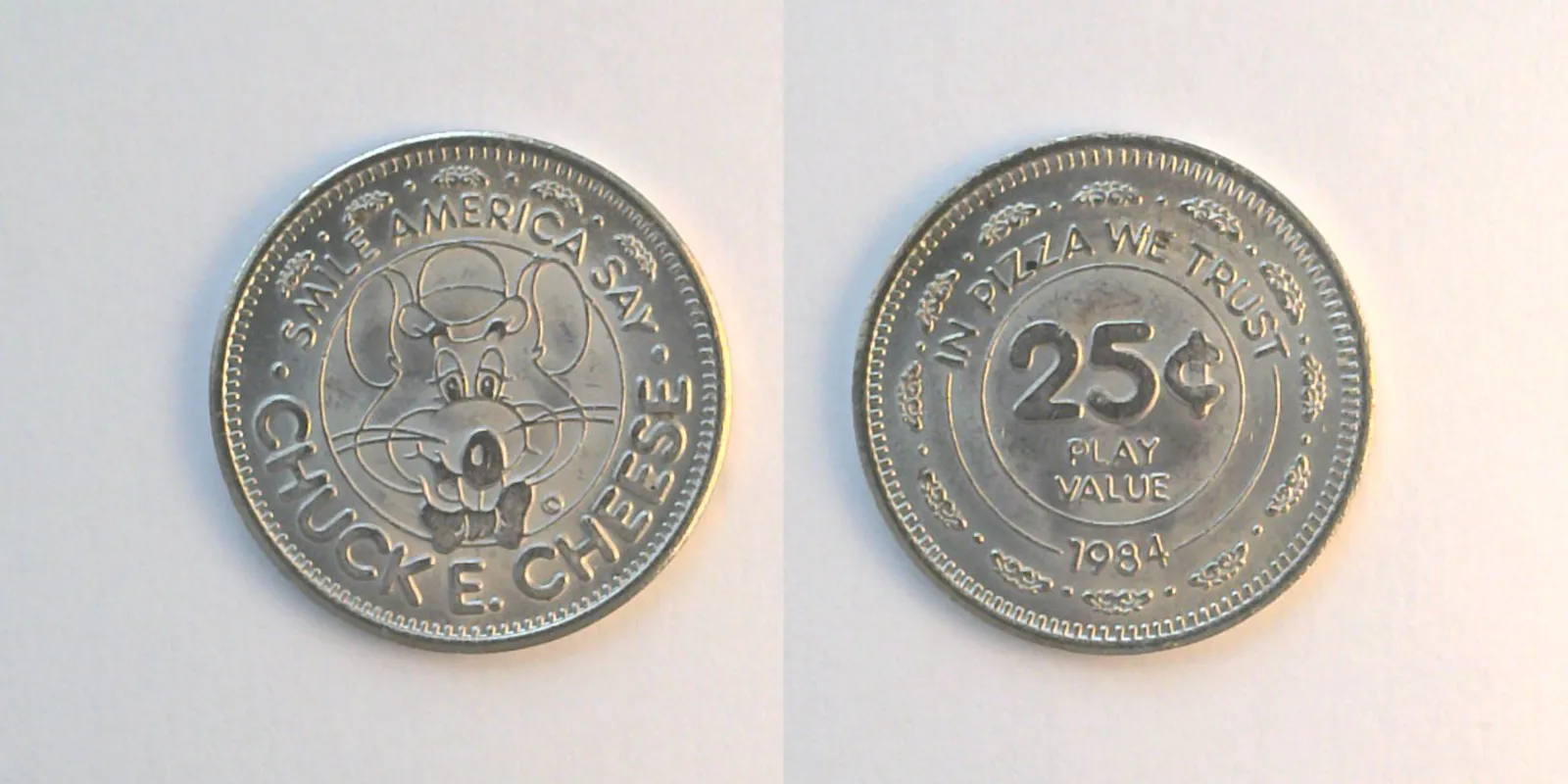
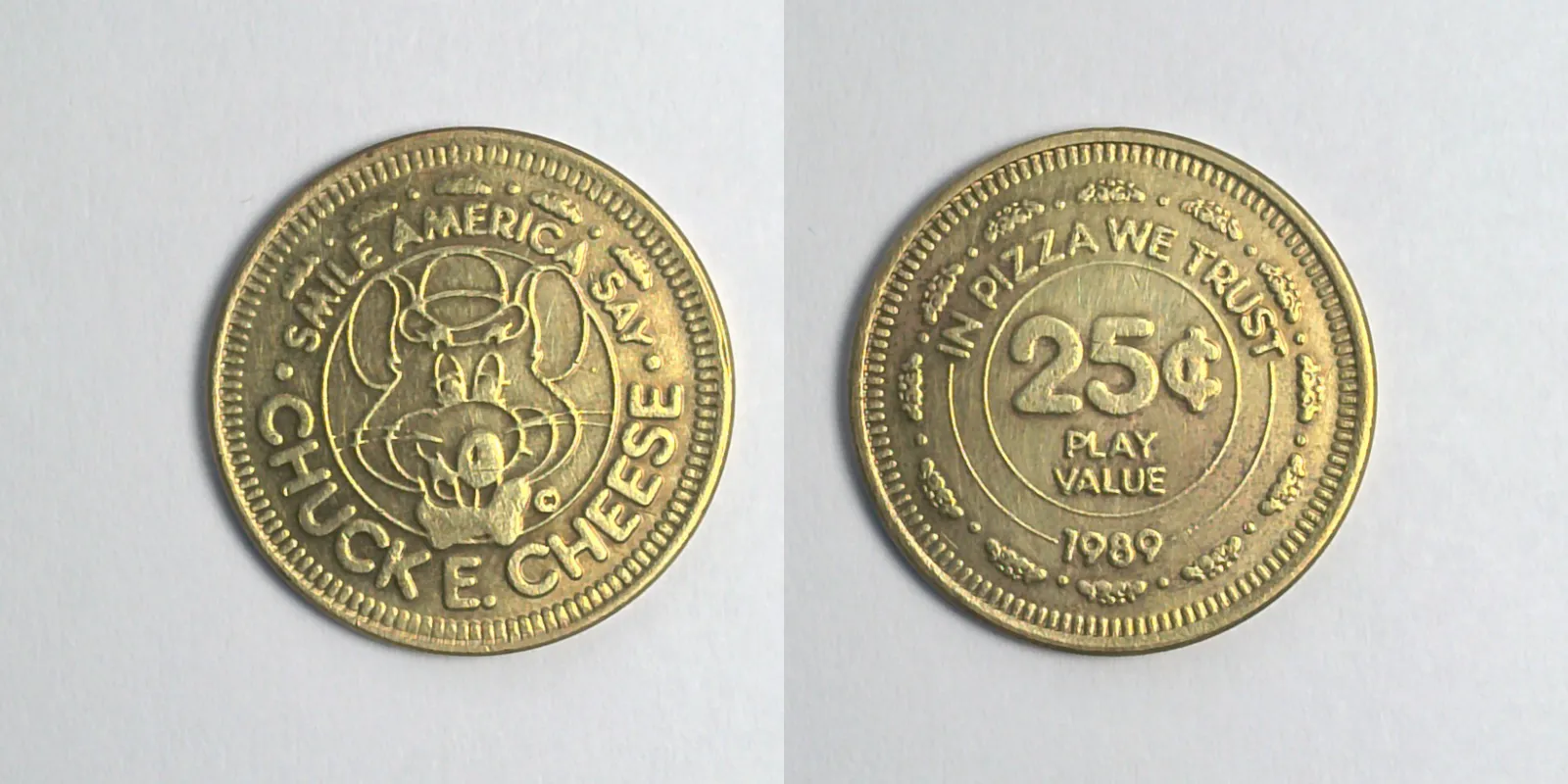
Front: A headshot of Tux Chuck with the slogan “Smile America Say Chuck E. Cheese” around the design.
Back: A cleaner, more standardized layout: “25c Play Value” in the center, “In Pizza We Trust” above, and the vintage year below. (There are a few font/thickness styles, but the overall idea stays consistent.)
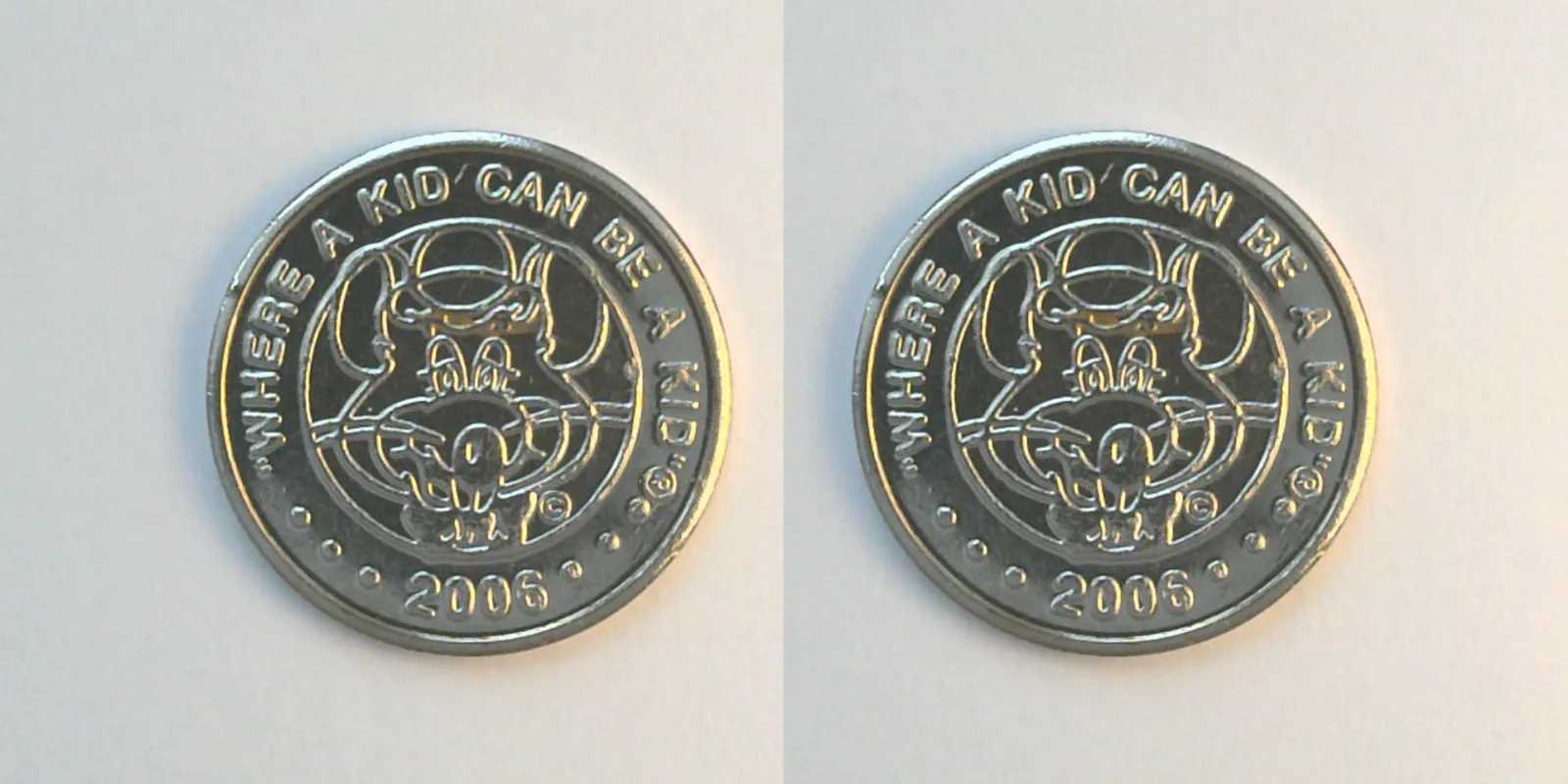
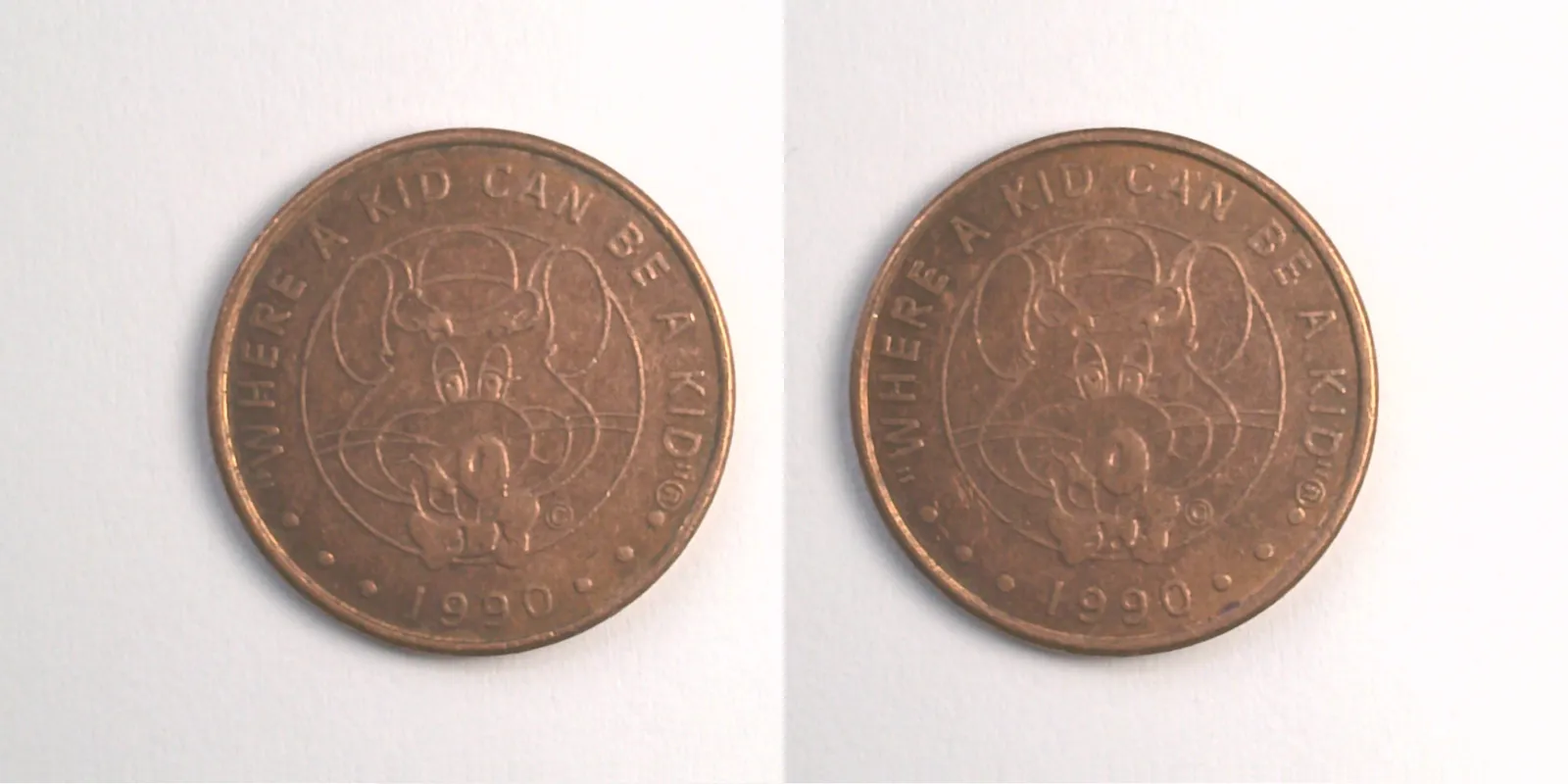
Type 3: “Kid Can Be a Kid” Tux Chucks (1990–2006)
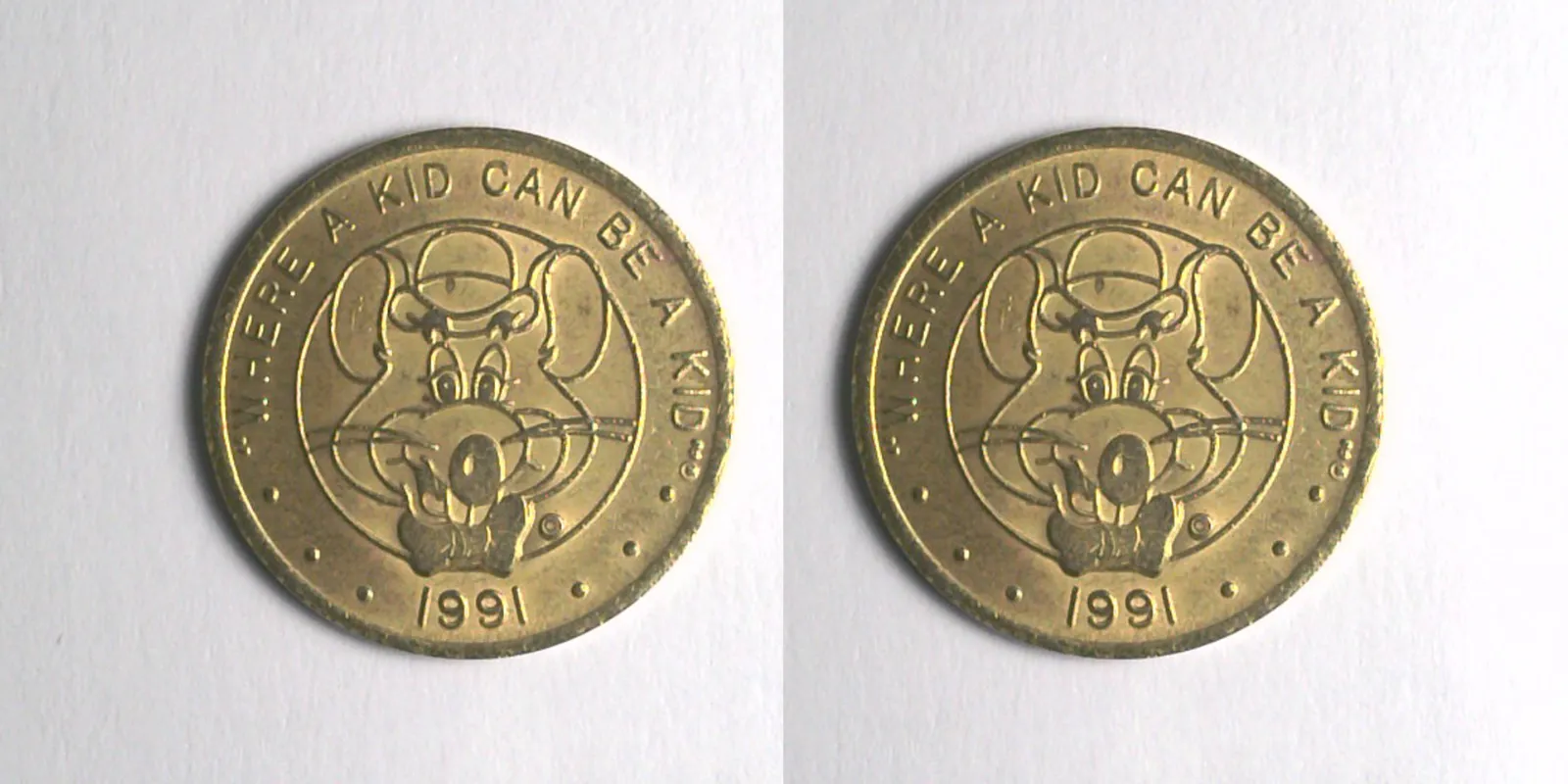
Type 3 keeps the general “adult Chuck” look, but updates the branding to one of the most iconic slogans of the entire chain.
Front and back: This era uses the same design on both sides, featuring Chuck along with the phrase “Where A Kid Can Be A Kid.”
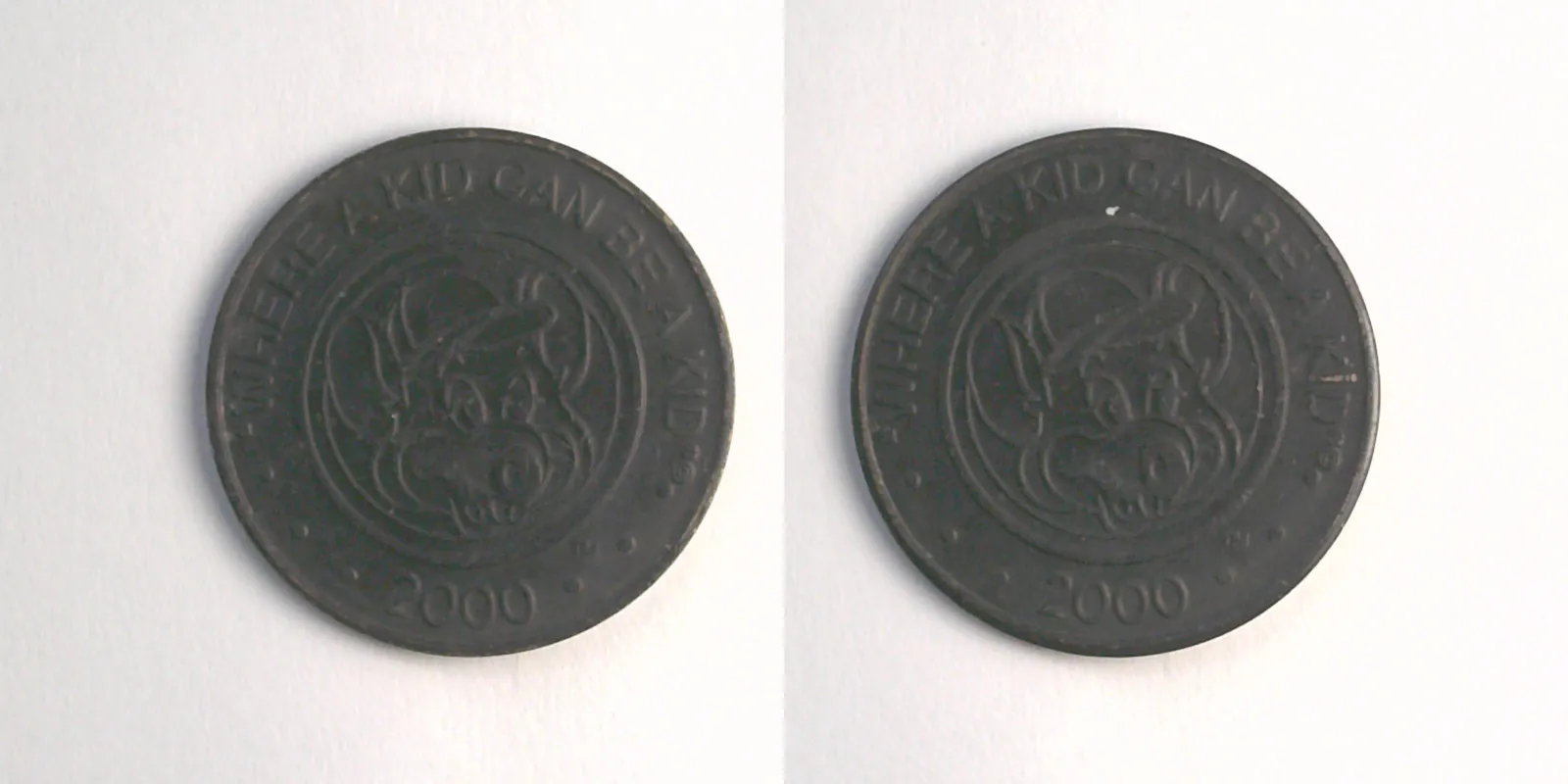
Type 4a: Avenger Chucks (1995–2000)
This era moves into a younger, more “action cartoon” style Chuck. If Type 3 is the classic slogan era, Type 4 is the classic “90s/early-2000s Chuck energy” era.
Front and back: Like Type 3, Type 4 generally uses the same design on both sides, still tied to the “Where A Kid Can Be A Kid” branding.
Type 4 tokens were produced in huge quantities, so they’re a very common “starter era” for collectors, especially if you’re pulling tokens out of old drawers, arcade jars, or childhood souvenirs.
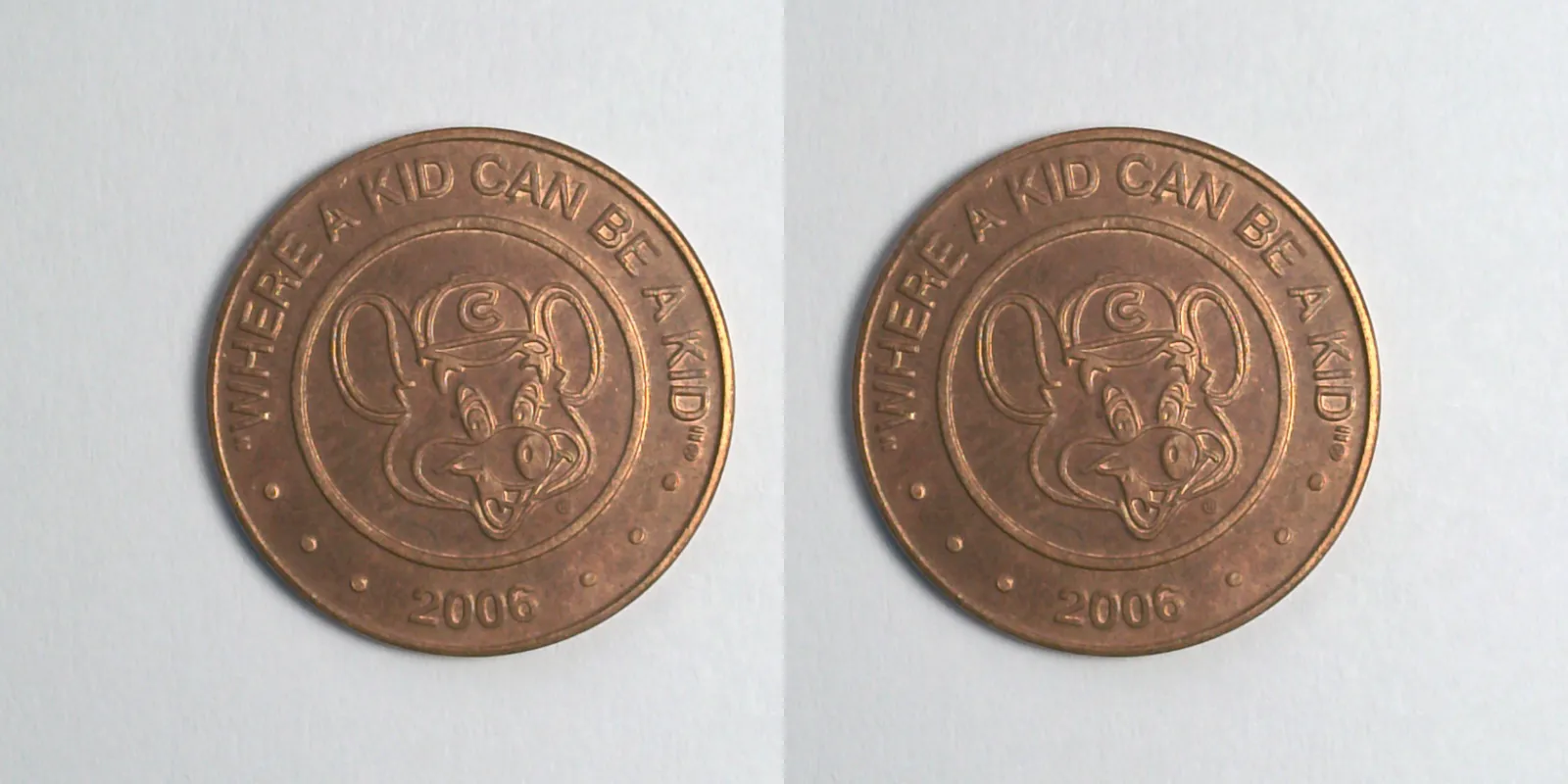
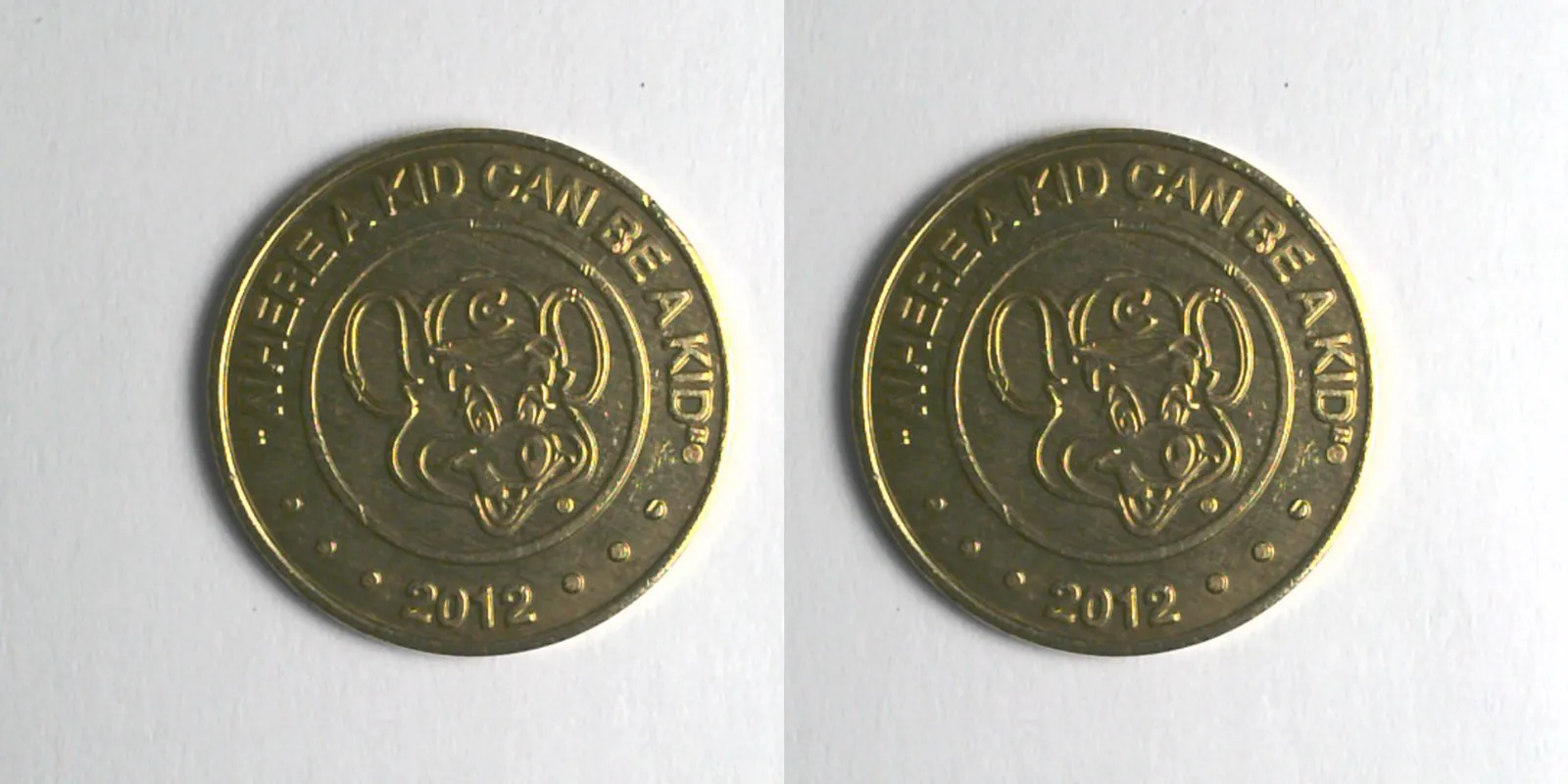
Type 4b: Avenger Chucks (2001–2012)
The only difference between 4a and 4b is that Chuck now has a "C" on his hat in 4b.
Front and back: Like Type 4a, 4b uses the same design on both sides, still tied to the “Where A Kid Can Be A Kid” branding.
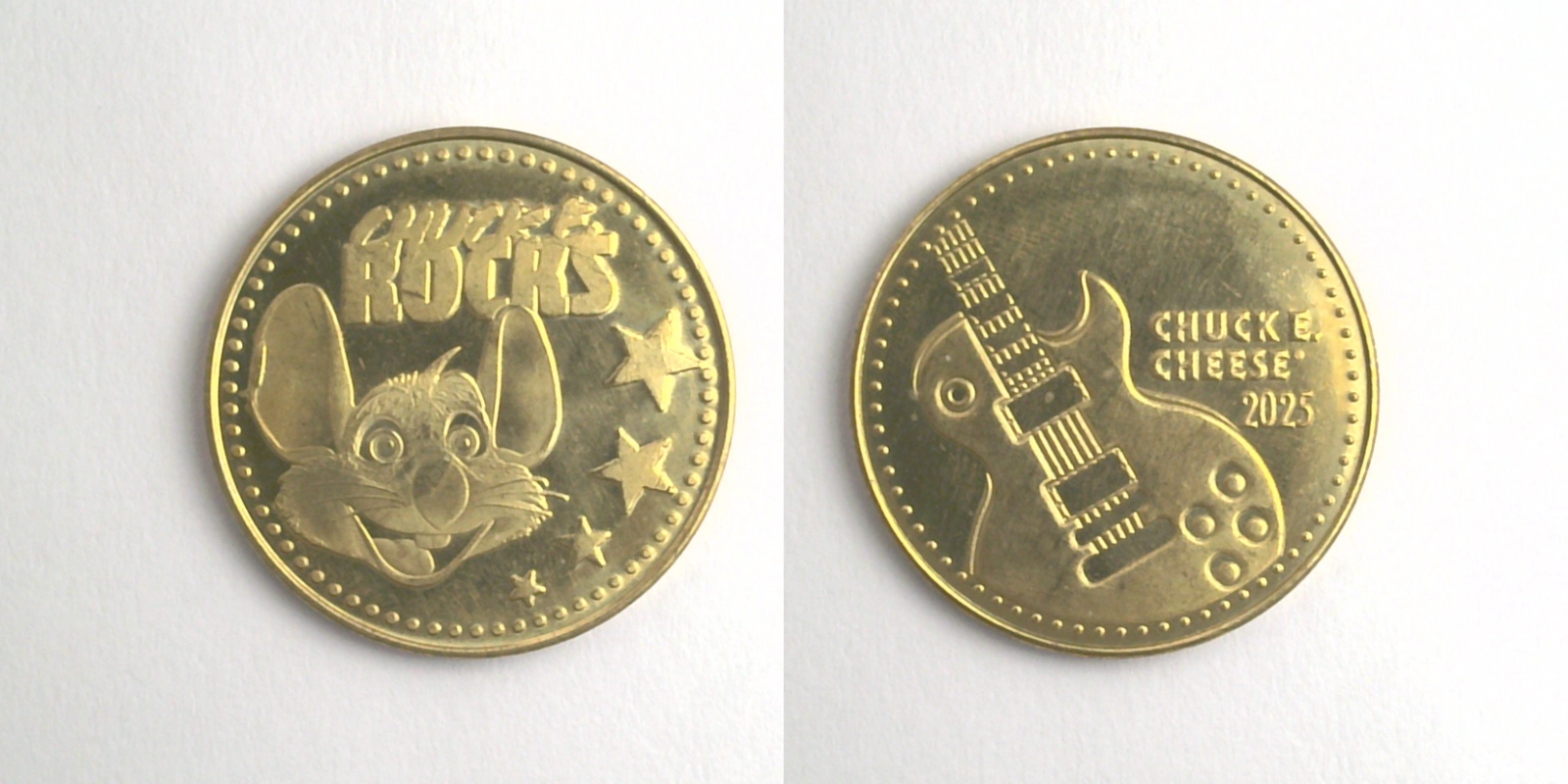
Type 5: Rockstar Chucks (2013–2025)
If you’ve ever seen a Chuck E. Cheese token with a guitar and thought, “Okay, this is extremely 2010s,” welcome home.
Front: An electric guitar design with Chuck E. Cheese branding around it.
Back: The phrase “Chuck E Rocks” paired with a very youthful “baby-faced” Chuck design.
These are the “end of the token era” tokens, especially because the Play Pass rollout reduced how many tokens were needed (or minted) in many locations.
The visual era walk
One token per major era, in chronological order:
1977 Chuck E Cheese Token (101B)
1983 Chuck E Cheese Token (201B)
1990 Chuck E Cheese Token (301C)
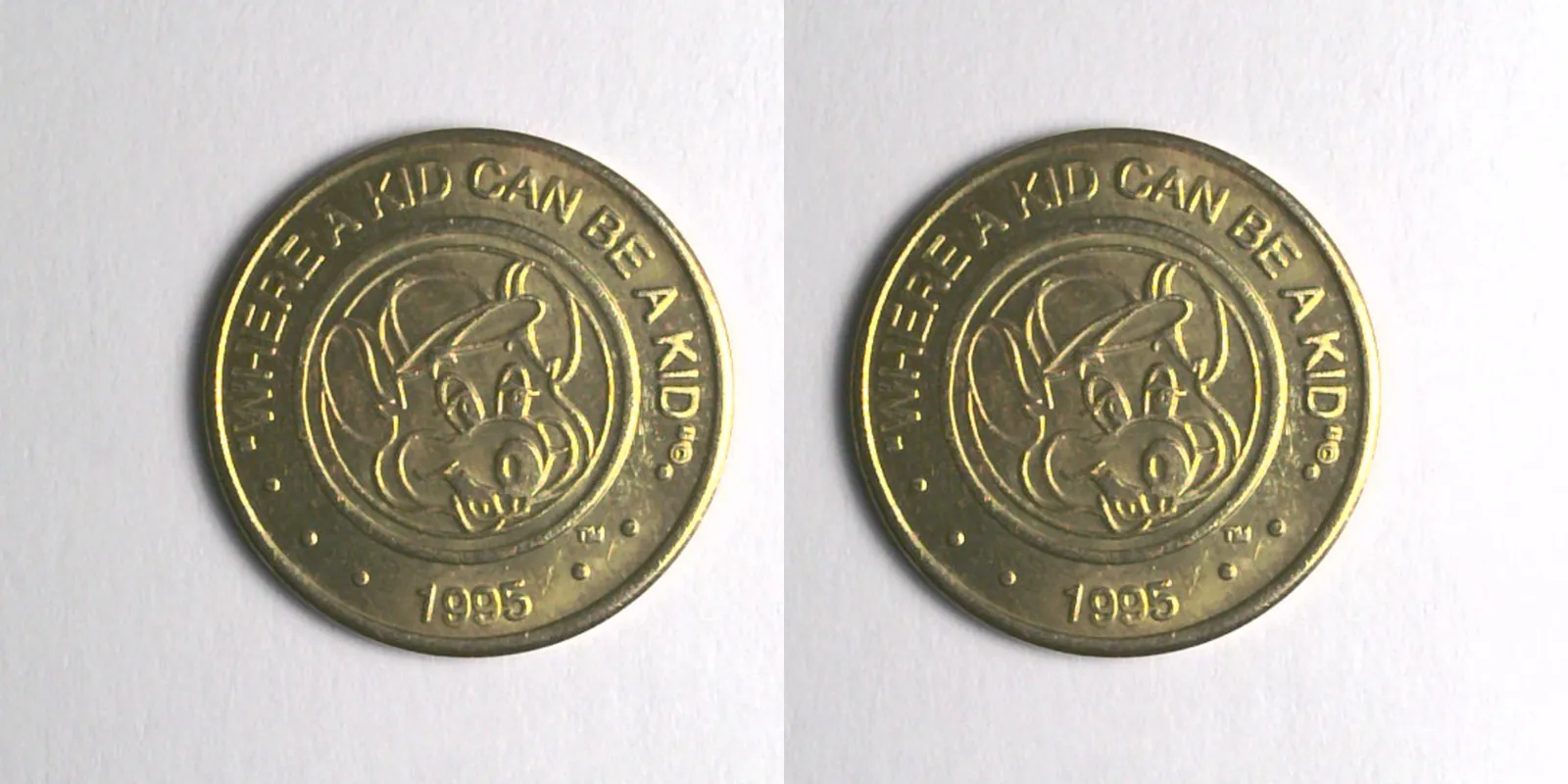
1995 Chuck E Cheese Token (401B)
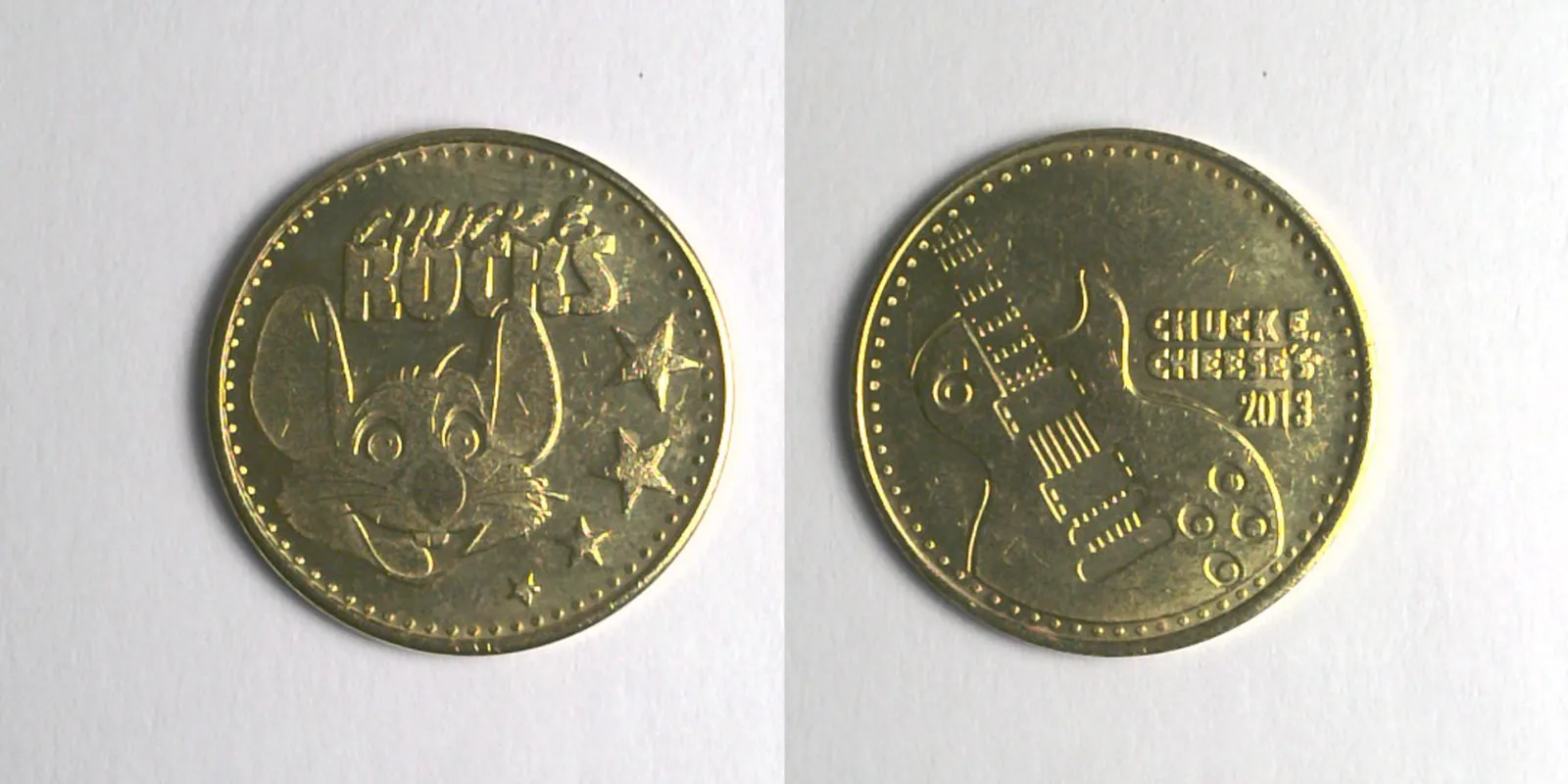
2013 Chuck E Cheese Token (501B)
Catalog-wide price trend
A note before you go hunting
This guide is intentionally high-level,the fun “big buckets” that let you quickly recognize what you’re holding.
Once you get deeper, there are tons of subtle details collectors track: small text changes, tiny marks, diameter differences, composition quirks, and other nerdy goodness. That’s all real… and it deserves its own guide where we can zoom in without turning this page into a microscope manual.