Every token in the catalog has a detail page at /items/
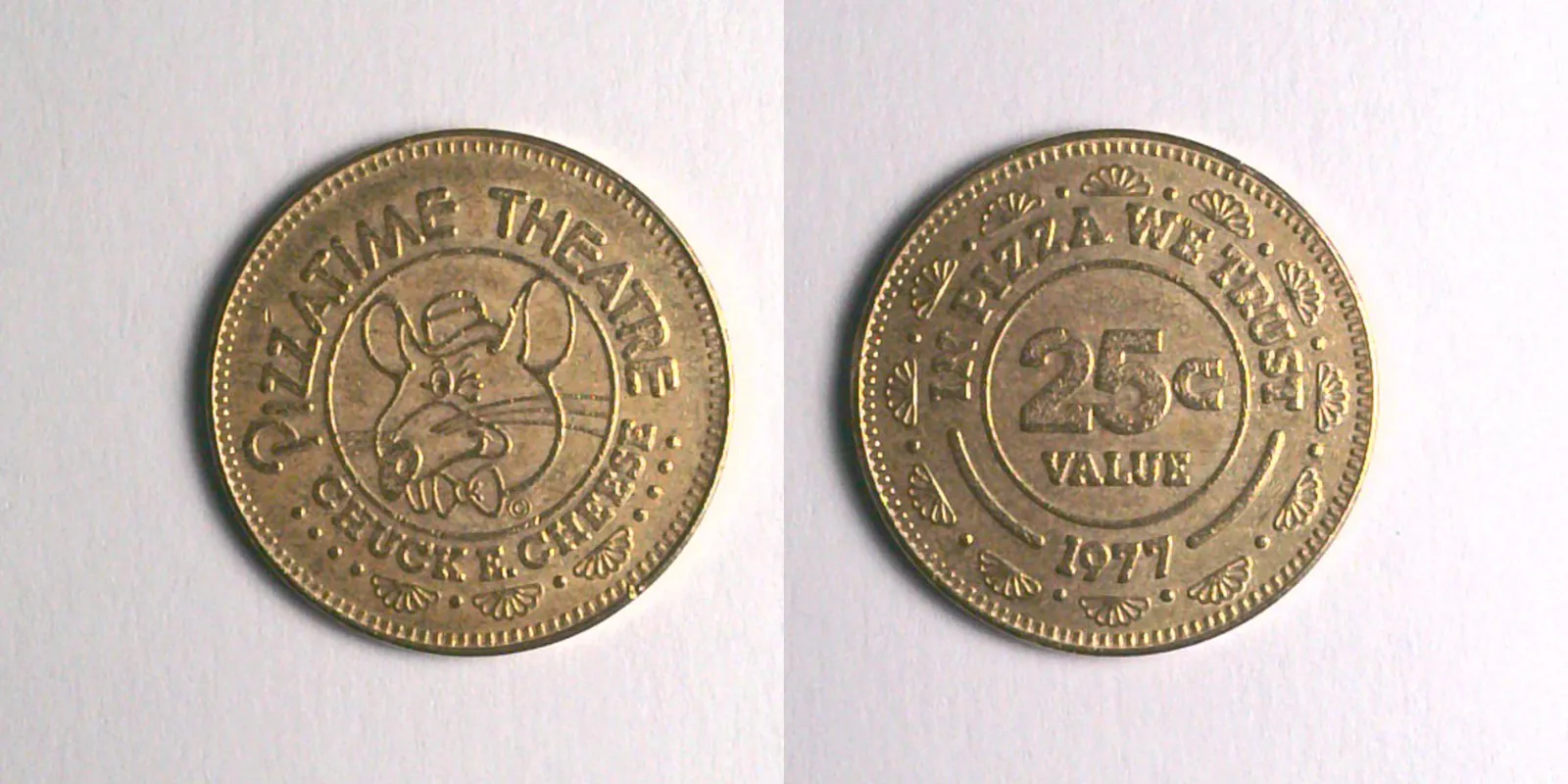
The image area
The top of the page shows the token's images. Most catalog entries have two:
- Primary image: the canonical front-of-token view used in lot images and search results.
- Secondary image: usually the back, or a different angle.
Where canonical images exist, they're studio-quality photos of an actual specimen. Some catalog entries (especially for rare or recently-added tokens) still rely on sample images pulled from eBay listings instead of canonical photos. Those work but look less polished.
The specifications block
To the right of the images sits the specifications block. Every field that has a value is shown; empty fields are hidden. You'll typically see:
- Catalog code: the cectoken.com numbering system identifier. For example, 101B is the first Chuck E. Cheese rat-head token in brass. See the Compositions, Sizes, and Terms guide for the full naming scheme.
- Vintage: the year the token was produced. Catalog tokens span 1977 to 2025.
- Diameter: physical size, displayed in millimeters. Standard arcade tokens cluster around 22-25 mm; larger medals can reach 60+ mm.
- Composition: the metal or material. Most tokens are brass, with smaller populations in nickel, copper, anodized nickel (a wide color spectrum), and the occasional wood, plastic, or anodized aluminum.
- Location: when the token references a specific city or location (most Chuck E. Cheese Type 1b city tokens, for instance).
- Front text / Back text: the literal text struck on each side.
- Variety: distinguishing notes that separate this catalog entry from similar ones.
- Mint mark: the manufacturer's mark, where present. RWM (Roger Williams Mint), HM, HH, and OC are the most common.
- Coin or Medal orientation: refers to die alignment. Coin: front upright, back inverted. Medal: both sides upright together.
Rarity tier
The rarity badge appears prominently near the title, with a visual symbol that matches the tier:
| Tier | Symbol | Meaning |
|---|---|---|
| R1 | Circle | Very Common |
| R2 | Square | Common |
| R3 | Diamond | Scarce |
| R4 | Hexagon | Rare |
| R5 | Star | Very Rare |
Rarity is judged by how often the token surfaces in the market and in known collections, not just how many were minted. A token that was minted in vast quantities but rarely gets listed for sale can still rate R4 or R5 if collectors aren't seeing them move.
Fair value
The fair-value figure is the site's current pricing estimate. It's derived from recent sales data: the site tracks eBay sold listings continuously and computes a representative per-unit price for each cataloged token.
Fair value updates as new sales come in. A token with no sales history shows no fair-value figure (those entries get filtered out of fair-value-based calculations).
The rarest token in the catalog currently has a fair-value estimate of $2,062.60.
Sales history
Below the specifications is the sales-history table. Every sale the site has scraped for this token is listed, with:
- Sold-at date
- Unit price: the per-token price after dividing the listing total by the quantity sold
- Quantity: how many tokens were in that listing
Above the table, two callouts surface the most useful aggregates:
- Last sale: the most recent sold date and unit price.
- Peak price: the highest unit price ever recorded for this token, with the date it sold.
If the catalog says a token has a peak price of (say) $400 but a typical recent price of $80, that's worth knowing: the peak might have been a condition outlier or an auction with two motivated bidders.
Top owners
A small section lists the top three collectors who own the most copies of this token, with a link to each one's profile. If you're researching a rare piece, this is one of the quickest paths to a knowledgeable contact.
A line below the top three tells you how many other collectors also own this item.
Related items
The "Related items" section surfaces other tokens that share key attributes with this one: same brand, same type, same composition. Useful for navigating laterally through a brand's catalog or comparing variants.
Related guides
When a guide exists for the token's brand group, that guide (and up to two others from the same brand group) shows up at the bottom of the page. Currently there are guides for every major brand group.
Adding to your collection
Logged-in users see an Add to collection button. Clicking it records ownership at quantity 1; clicking again increments. See Tracking your collection for more on what happens behind that button.
Where to go next
- Searching and filtering explains how to navigate to items without knowing the catalog code.
- Compositions, Sizes, and Terms is the canonical glossary for the technical vocabulary used on every item page.